WhatsApp Business paid messaging: New pricing rules begin from October 1
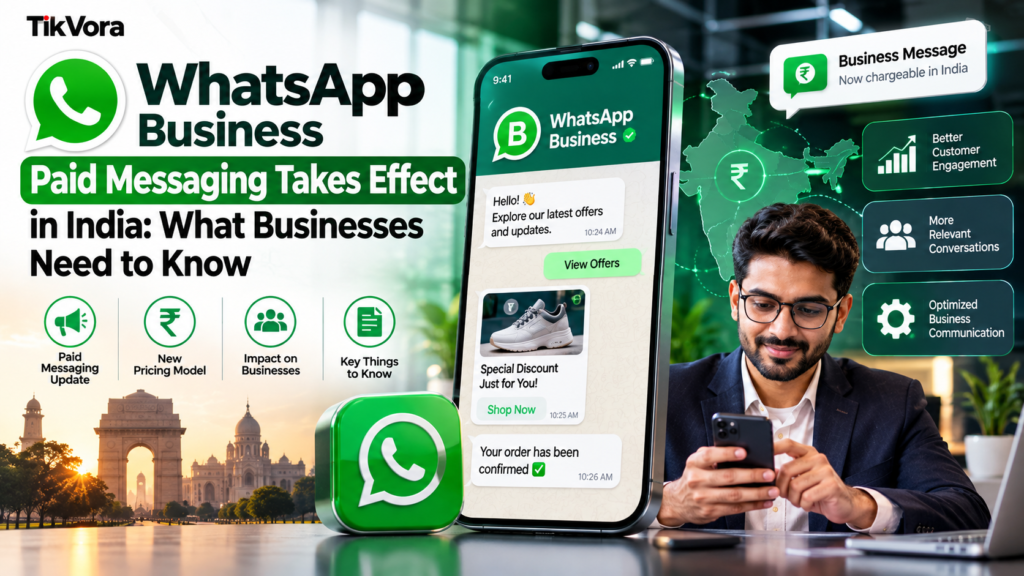
WhatsApp Business paid messaging: Meta has introduced a new pricing structure for businesses using the WhatsApp Business Platform in India. The changes took effect on October 1, 2026, and will increase the cost of sending several types of business messages, including customer-service replies, order confirmations, delivery updates and authentication messages.
WhatsApp Business paid messaging: The change does not mean that ordinary WhatsApp users will have to pay to send or receive messages. Customers can continue to use WhatsApp as usual. The new charges apply to businesses that use the WhatsApp Business Platform, either through a direct integration or through an authorised technology provider.business.
WhatsApp Business paid messaging Under the revised system, businesses will receive 1,000 free service messages per business phone number every month. After the free allowance is exhausted, each additional service message in India will cost ₹0.115 before applicable taxes. Meta’s new system is based on delivered messages, meaning businesses are charged when eligible messages are delivered to customers.business
Customers will not be charged
WhatsApp Business paid messaging The most important point for WhatsApp users is that these charges are not being passed directly to customers. People will not have to pay a fee for replying to a company, checking an order, receiving a delivery notification or contacting customer support.
The payment responsibility lies with the business. A customer who sends a message to a bank, online store, airline, hospital, school or other organisation will continue to use WhatsApp without a separate messaging charge.
WhatsApp Business paid messaging However, businesses may review their communication strategies because the new rates can increase their operating costs. Companies that send millions of notifications every month may need to adjust their technology budgets, message frequency and customer-engagement plans.
What are service messages?
Service messages are generally communications connected to an existing customer interaction. They may include replies sent by a business representative or an automated system during a customer-service conversation.
Examples include:
- Replies to a customer’s question about a product.
- Assistance with an existing booking or order.
- Responses to a complaint or support request.
- Information supplied after a customer contacts the company.
- Non-template replies generated by a customer-service team or artificial intelligence system.
WhatsApp Business paid messaging Meta is providing 1,000 free service messages per business phone number each month. Once that limit is crossed, businesses will be charged for additional service messages at the applicable Indian rate.business-
The allowance applies separately to each business phone number. A company operating several numbers may therefore have separate monthly allowances, although its total cost will depend on message volumes and the categories of messages it sends.
Utility messages become chargeable
WhatsApp Business paid messaging The pricing change also affects utility messages. These are messages linked to a transaction, account or service that a customer has already requested.
Common examples include order confirmations, shipping updates, appointment reminders, payment notifications and account-related alerts. In India, the utility message rate is listed at ₹0.115 per delivered message before GST.
WhatsApp Business paid messaging Previously, some messages sent within WhatsApp’s 24-hour customer-service window were available to businesses without an additional message charge. The revised rules change that treatment for utility communications. A business may still be allowed to respond during the customer-service window, but eligible utility messages can now attract a fee.
For example, suppose a customer contacts an online retailer about an order. The retailer may need to send a confirmation, provide a tracking update and respond to a delivery question. Depending on how those messages are classified, the company may now pay for the delivered messages even though the conversation was initiated by the customer.
WhatsApp Business paid messaging This makes message classification more important than before. Businesses must ensure that a message genuinely relates to a transaction or support request. A promotional message should not be presented as a utility message simply to obtain a lower rate.
Authentication messages remain part of the paid system
WhatsApp Business paid messaging Authentication messages are used to verify a customer’s identity or confirm access to an account. One-time passwords, login codes and account-verification messages are common examples.
These messages are especially important for banks, financial technology companies, e-commerce platforms, travel services and digital applications. Under the updated Indian pricing structure, authentication messages are charged at the applicable rate for this category. Reports on the new rate card place the Indian rate at ₹0.115 per delivered message before GST.
Although the cost of a single message is small, the total amount can become significant for companies with large customer bases. A platform sending several million verification messages every month will need to consider both the per-message charge and any additional fees applied by its technology provider.
WhatsApp Business paid messaging Businesses may respond by improving delivery accuracy, reducing unnecessary resend attempts and giving customers alternative verification options. Better system design can also help prevent a customer from receiving multiple codes for one login request.
Marketing messages remain more expensive
WhatsApp Business paid messaging Marketing messages are different from service, utility and authentication communications. They promote a product, discount, sale, new service or other commercial opportunity.
Meta continues to charge a higher rate for marketing messages in India. The reported rate is ₹0.8631 per delivered marketing message.
This distinction is important because a company cannot treat a promotional communication as a service message merely because the customer has previously interacted with the business. For example, an order-confirmation message may be a utility communication, but an advertisement for a new product sent after the order may be considered marketing.
Businesses need to review message templates carefully. A message that combines a genuine service update with an unrelated promotional offer could create classification and compliance problems. Separating transactional information from advertising may help companies control costs and maintain clearer communication with customers.
Payment method is now essential
Businesses using the WhatsApp Business Platform are required to add a valid payment method to their messaging accounts. This applies to companies working directly with Meta as well as those using a solution provider or business-technology partner.
WhatsApp Business paid messaging Reports indicate that businesses were required to configure a payment method by September 30, 2026, before the revised pricing came into effect. Meta has warned that service messages may not be delivered where the required payment setup is missing.english.
This requirement means businesses should monitor their account balance, billing profile and payment status. A failed card, expired payment method or incomplete billing setup could interrupt important customer communications.
WhatsApp Business paid messaging For companies that depend on WhatsApp for order updates or customer support, even a short interruption can create confusion. Customers may not receive delivery information, appointment reminders or responses to support questions. Businesses should therefore maintain an alternative support channel, such as email, telephone assistance or an in-app notification system.
Free conversations from advertisements
Some conversations that begin when a customer clicks a WhatsApp advertisement continue to receive special treatment. Reports say messages in conversations initiated through a WhatsApp business advertisement can remain free under the applicable rules.
This arrangement is designed to encourage customers to move from an advertisement into a direct conversation with a business. It may benefit companies that use click-to-WhatsApp advertising campaigns to generate leads, answer questions or guide customers toward a purchase.
WhatsApp Business paid messaging However, businesses should not assume that every conversation connected to advertising will remain free indefinitely. The applicable category, duration and eligibility conditions can depend on Meta’s current business-messaging rules. Companies should check their account-level pricing information and the terms supplied by their business solution provider.
Impact on Indian businesses
The pricing change will affect businesses differently. Small firms with limited message volumes may remain within the 1,000-message monthly service allowance. For them, the direct impact may be limited, although utility and marketing messages can still create charges.
Medium-sized companies may need to examine the number of customer conversations they handle each month. Retailers, clinics, educational institutions, logistics companies and service providers could see increased costs if they use WhatsApp for frequent notifications and support replies.
WhatsApp Business paid messaging Large enterprises are likely to face the biggest financial impact. E-commerce platforms, banks, telecom companies, travel firms and food-delivery services may send very high volumes of authentication, utility and customer-service messages. Even a charge of a few paise per message can become a sizeable monthly expense when multiplied across millions of deliveries.
For example, one million utility messages at ₹0.115 each would represent ₹115,000 before taxes. A company sending one million marketing messages at ₹0.8631 each would face a much larger basic messaging cost. Actual billing may also depend on Meta’s pricing rules, taxes, currency treatment and the fees charged by a third-party provider.
How businesses can control costs
Businesses can take several practical steps to manage the new system.
First, they should audit their monthly message volume. The audit should separate service, utility, authentication and marketing messages instead of treating all communication as one category.
WhatsApp Business paid messaging Second, companies should remove unnecessary notifications. Sending several messages for the same order or account event increases costs and may also irritate customers. Important information can often be combined into one clear message.
Third, businesses should improve their customer-service workflows. Automated systems should avoid repeated replies, duplicate notifications and unnecessary authentication-code requests. A well-designed support system can reduce both operational costs and customer frustration.
Fourth, companies should review message templates. Templates should accurately reflect the purpose of the communication. Clear classification will help prevent billing surprises and reduce the risk of promotional material being sent under a transactional label.
Finally, businesses should compare the cost of WhatsApp messaging with other channels. WhatsApp remains valuable because of its high reach and familiar interface, but companies may decide to use email, SMS, mobile-app notifications or web-based support for selected communications.
What customers should expect
Customers are unlikely to see a direct charge when they message a business on WhatsApp. The main possible change may be in how businesses manage their communication.
Some companies could send fewer non-essential updates. Others may move certain notifications to email or mobile applications. Businesses may also become more careful about asking customers to start a conversation before providing support.
WhatsApp Business paid messaging Customers should continue to be cautious with links, payment requests and one-time passwords. The introduction of business messaging charges does not make every message from a company genuine. Users should verify suspicious requests through official websites or customer-care numbers and should never share confidential authentication codes.
A shift toward measured business communication
Meta’s new pricing structure marks a shift from broad, low-cost business messaging toward a more measured communication model. Businesses will need to pay closer attention to the purpose, timing and volume of each message they deliver.
For customers, WhatsApp remains free for ordinary personal and business conversations. For companies, however, the platform is becoming a more closely managed business channel, with separate prices for service, utility, authentication and marketing communication.
The change may increase costs for high-volume senders, but it could also encourage better customer communication. Businesses that reduce duplicate alerts, separate promotional material from essential updates and maintain accurate billing information will be better placed to manage the new rules.
WhatsApp Business paid messaging As India continues to adopt digital commerce and online customer support, WhatsApp is expected to remain an important communication platform. The key difference is that businesses must now treat every large-scale message campaign as a measurable operating expense rather than an entirely free customer-service activity.
TIKVORA — Your trusted source for AI News, AI Tools, Technology, Startups, Innovation, Machine Learning, Generative AI, and Digital Trends. Fast, clear, and reliable updates on the technologies shaping the future.
Stay connected with the latest Indian News, World News, Breaking News, Latest Updates, Political News, Business & Stock Market, Sports, Technology & Digital, Entertainment, and Trending News with SACHKI KHABAR. Get fast, clear, and reliable updates on what is happening across India and around the world. Visit SACHKI KHABAR for the latest stories and important developments.