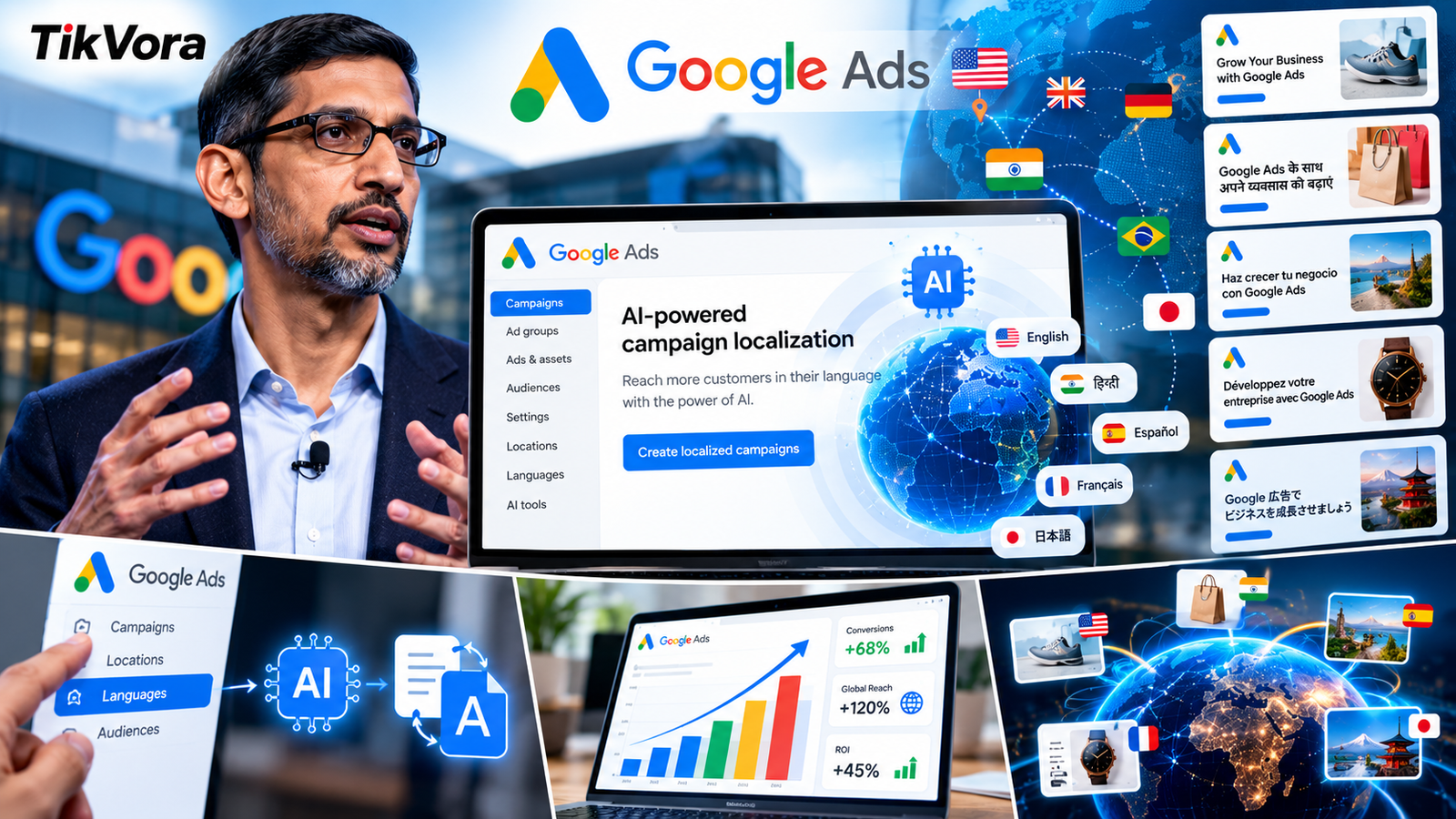
Google Ads AI campaign localization has quietly rolled out one of its most practical AI innovations yet: an AI-powered campaign localization tool that can translate entire Search campaigns into new languages and markets with just a few clicks. This beta feature, announced in early October 2026, promises to slash the time, cost, and complexity of international advertising expansion. For businesses in India and across the globe eyeing overseas growth, this could be the breakthrough that finally makes cross-border advertising accessible without hiring translation agencies or building separate campaigns from scratch.
Google Ads AI campaign localization Why This Matters for Advertisers
Google Ads AI campaign localization Taking a Search campaign into another country has traditionally been a manual, expensive, and error-prone process. Advertisers had to translate headlines, descriptions, keywords, sitelinks, and callouts separately, often juggling spreadsheets, external translators, and multiple campaign builds. Each market required its own budget setup, bid strategy, and landing page adaptation. Small mistakes in translation could waste budgets or damage brand reputation.
Google Ads AI campaign localization Google’s new AI localization tool changes all of that by bringing the entire workflow into a single, AI-driven process inside Google Ads. Instead of weeks of preparation, advertisers can now generate a localized campaign in minutes, review it, and launch it with confidence. For Indian businesses targeting Europe, North America, or Latin America, this dramatically lowers the barrier to entry.
How the AI Localization Tool Works
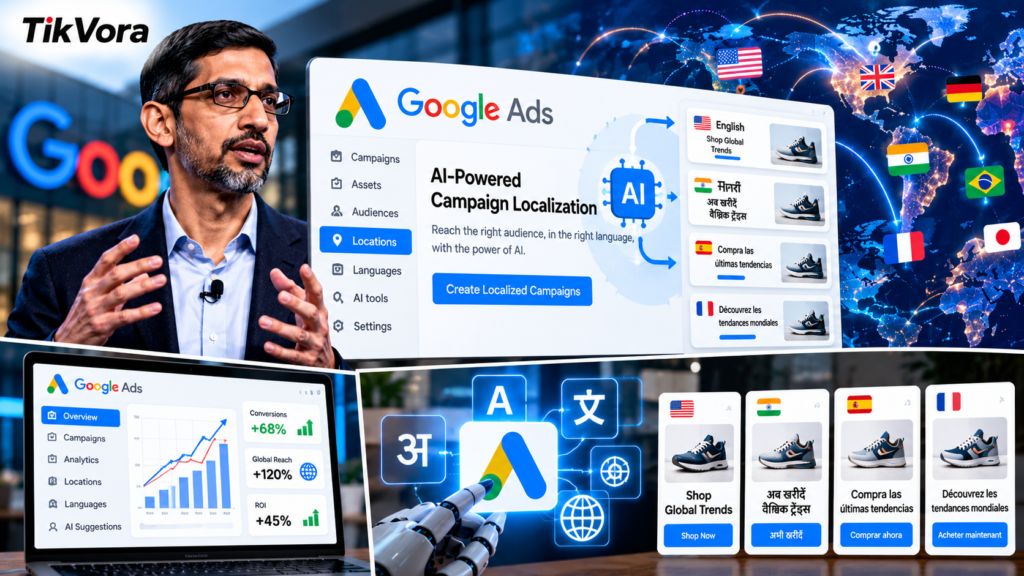
Google Ads AI campaign localization The process is straightforward. Advertisers start by selecting an existing eligible English (U.S.) Search campaign in their Google Ads account. They then choose a target language and location from the supported list. Google’s AI creates a completely new, independent localized campaign based on the original. The original campaign remains untouched, so there’s no risk of disrupting existing performance.
Google Ads AI campaign localization What gets translated? Everything that matters: headlines, descriptions, sitelinks, callouts, and keywords. For image ads containing text, the AI can even remove the original text and replace it with translated messaging as supplemental text assets. This level of automation was previously impossible without manual creative adaptation.
Landing Page Localization: A Critical Addition
One of the smartest features is landing page support. Advertisers have two options: they can install a Google-provided JavaScript snippet that dynamically translates landing-page text for visitors arriving from localized ads, or they can point the new campaign toward existing localized pages using URL updates. This ensures that the entire user journey, from ad click to conversion, feels native to the target market.
For Indian e-commerce brands, SaaS companies, or service providers targeting international customers, this means they no longer need fully translated websites before testing new markets. They can start with AI-translated landing pages, measure performance, and invest in professional localization only for markets that show promise.
Advertiser Control and Custom Instructions
A common concern with AI translation is loss of brand voice or incorrect terminology. Google addresses this by allowing advertisers to provide natural-language instructions to guide the AI. Examples include: “Don’t translate the brand name,” “Keep the tone formal,” or “Use industry-specific terms for fintech.” These instructions give the AI context about how the localization should be handled, ensuring outputs align with brand guidelines Google Ads AI campaign localization
This level of control is crucial for Indian brands with unique value propositions or culturally specific messaging. A startup selling Ayurvedic wellness products, for instance, can instruct the AI to preserve Sanskrit terms or maintain a holistic, traditional tone even in English or Spanish markets.
The Review Process: Back-Translation for Accuracy
Google doesn’t expect advertisers to blindly trust AI outputs. The review interface shows three columns side by side: the original asset, the localized version, and a back-translation into English. This back-translation helps advertisers check meaning and intent even if they don’t speak the target language. If something looks off in the back-translation, it’s a red flag that the localized version may have drifted from the original message
This feature is especially valuable for Indian advertisers who may not have in-house teams fluent in German, French, or Portuguese. They can still validate quality before launching campaigns, reducing the risk of embarrassing mistranslations or culturally insensitive messaging.Google Ads AI campaign localization
Budgets, Bids, and Currency Considerations
Here’s an important catch: budgets and bids are copied directly from the original campaign without automatic currency conversion. If your original campaign runs with a daily budget of ₹5,000 INR, the localized campaign will also use ₹5,000 INR, even if targeting Germany or Brazil. Google does not perform exchange-rate adjustments, so advertisers must manually review and adjust budgets to ensure the economics make sense for each new market.Google Ads AI campaign localization
For Indian businesses, this means doing homework on local CPC rates, competition levels, and purchasing power before launching. A budget that works in Mumbai may be too low for Berlin or too high for Buenos Aires. Smart advertisers will use this tool to test markets quickly, then optimize budgets based on real performance data.Google Ads AI campaign localization
Supported Languages and Future Expansion
Google Ads AI campaign localization As of October 2026, the beta supports English (U.S.) Search campaigns translated into:
- Dutch
- French (including Canadian French)
- German
- Italian
- Polish
- Portuguese (Brazilian and European)
- Spanish (for Spain and Latin America/Caribbean)
Google has confirmed that additional languages are coming by the end of 2026. The company also plans to expand the localization tool beyond Search to support Performance Max campaigns, which would be a massive upgrade for advertisers running omnichannel strategies.
Google Ads AI campaign localization For Indian advertisers, this roadmap means more markets will become accessible over time. Expect support for Hindi, Tamil, or other Indian languages in the future as Google continues to invest in AI localization for emerging markets.
Why Indian Advertisers Should Pay Attention
Google Ads AI campaign localization India’s digital advertising market is booming, but domestic competition is fierce. Many Indian startups and SMEs are now looking abroad for growth: Indian SaaS companies targeting the U.S. and Europe, D2C brands eyeing the Middle East and Southeast Asia, and service providers expanding into Africa and Latin America.
This AI localization tool removes one of the biggest friction points: language. Instead of spending lakhs on translation agencies and waiting months to launch, Indian advertisers can now test international markets in days. They can validate demand, refine messaging, and scale only what works.Google Ads AI campaign localization
Consider an Indian edtech company wanting to enter Brazil. With this tool, they can localize their entire Search campaign into Portuguese, adapt landing pages, and launch within 48 hours. If performance is strong, they can invest in professional translation and creative adaptation. If not, they’ve lost minimal budget and gained valuable market insights.Google Ads AI campaign localization
Limitations and the Need for Human Oversight
AI translation is powerful, but it’s not perfect. Messaging that is technically accurate may still miss cultural nuances, local buying behavior, or brand-specific terminology. A phrase that works in the U.S. might sound awkward in Germany or even offensive in certain Latin American markets.
Google Ads AI campaign localization That’s why Google emphasizes that AI localization doesn’t eliminate the need for human oversight. Advertisers must still validate language quality, landing-page experience, targeting settings, and economic viability before turning localized campaigns live. For Indian brands, this means involving native speakers or local partners for final reviews, especially in high-stakes markets.
The Bigger Picture: AI Beyond Ad Creation
This launch is part of a broader trend at Google: extending generative AI beyond ad creation and bidding into campaign operations. Previously, AI in Google Ads was mostly about automated bidding, responsive search ads, and asset generation. Now, AI is automating another traditionally labor-intensive part of advertising: international expansion.
Google Ads AI campaign localization For advertisers, this signals a shift toward AI-assisted campaign management across the board. Future updates may include AI-driven market selection, competitive analysis, or even automated budget allocation across countries based on predicted ROI.
Practical Steps for Indian Advertisers
If you’re an Indian business considering international expansion, here’s how to get started with this tool:
- Audit Your Existing Campaigns: Identify high-performing English Search campaigns that could work in other markets.
- Research Target Markets: Understand local CPC rates, competition, and cultural preferences before launching.
- Use Custom Instructions: Provide clear guidance to the AI about brand tone, terminology, and non-translatable elements.
- Review Back-Translations: Carefully check the back-translated versions to catch any meaning drift.
- Adjust Budgets Manually: Don’t rely on copied budgets; adjust for local market economics.
- Test Landing Pages: Use the JavaScript snippet or existing localized pages to ensure a seamless user experience.
- Monitor and Optimize: Treat localized campaigns as experiments; scale what works and pause what doesn’t.
The Bottom Line
Google Ads’ AI-powered campaign localization is a significant step forward for global advertising. It democratizes international expansion, allowing businesses of all sizes to test new markets quickly and cost-effectively. For Indian advertisers, this is an opportunity to compete globally without the traditional barriers of language, translation costs, and operational complexity.Google Ads AI campaign localization
However, success still depends on human judgment. AI can generate localized campaigns in minutes, but advertisers must validate quality, cultural fit, and economic viability before going live. Those who combine AI efficiency with human insight will be the ones who win in international markets.
As Google continues to expand language support and add Performance Max integration, this tool will only become more powerful. For now, Indian advertisers should experiment with the beta, learn its strengths and limitations, and prepare for a future where global advertising is just a few clicks away.
Stay connected with the latest Indian News, World News, Breaking News, Latest Updates, Political News, Business & Stock Market, Sports, Technology & Digital, Entertainment, and Trending News with SACHKI KHABAR. Get fast, clear, and reliable updates on what is happening across India and around the world. Visit SACHKI KHABAR for the latest stories and important developments.
TIKVORA — Your trusted source for AI News, AI Tools, Technology, Startups, Innovation, Machine Learning, Generative AI, and Digital Trends. Fast, clear, and reliable updates on the technologies shaping the future.