
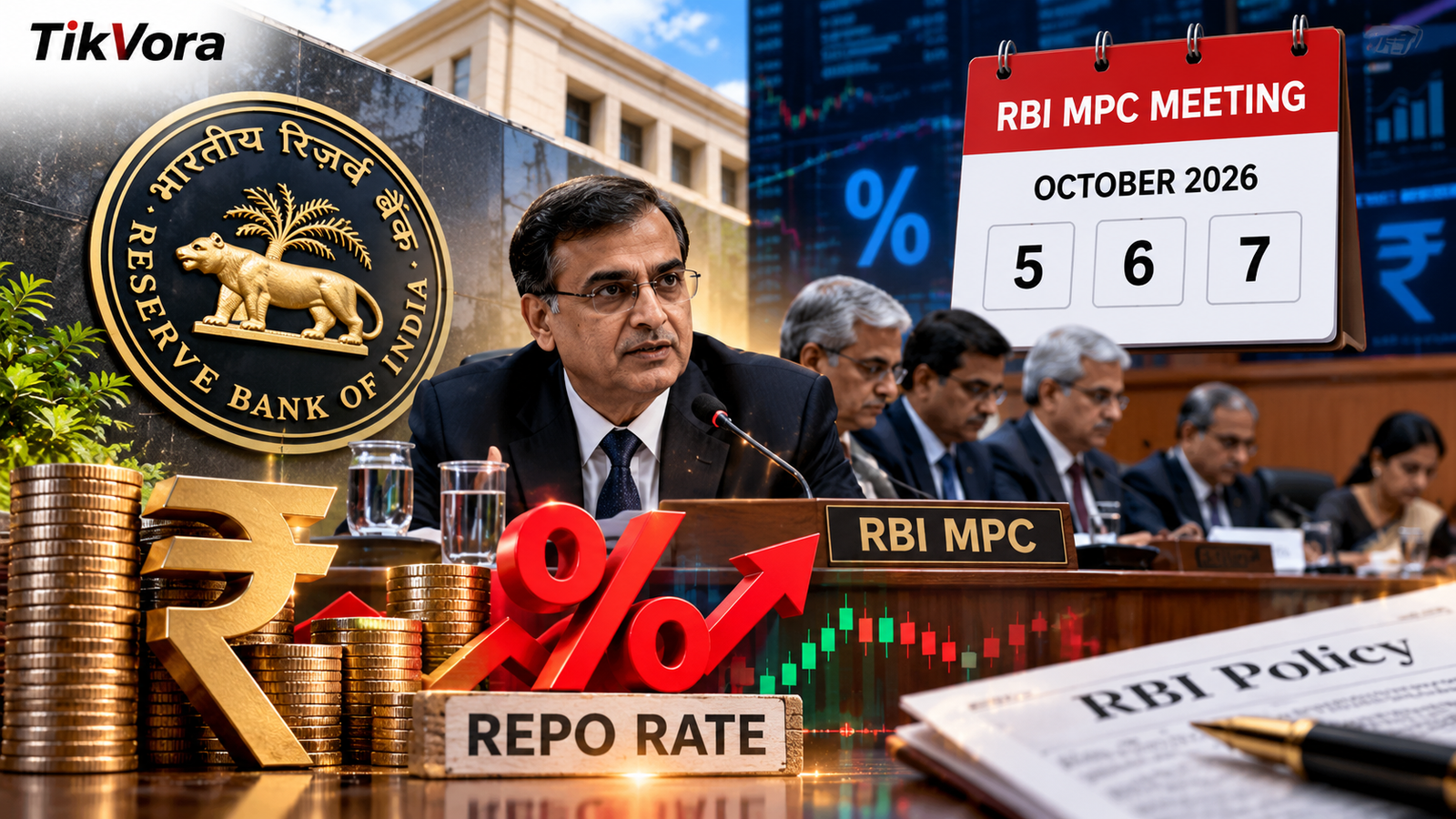
RBI MPC October 2026 The Reserve Bank of India’s Monetary Policy Committee is meeting from October 5 to 7, and all eyes are once again on the repo rate. After keeping the key lending rate unchanged at 5.25 per cent in its last four reviews, the central bank now faces a difficult question: should it begin tightening again, or wait for greater clarity on inflation and global conditions?
A majority of economists surveyed recently expect the RBI to raise the repo rate by 25 basis points to 5.50 per cent. If that happens, it would be the first increase since February 2023 and would signal a clear shift in the central bank’s priorities—from supporting growth to protecting price stability.RBI MPC October 2026
Why This Meeting Matters
RBI MPC October 2026 The October policy review is important because it comes at a time when India’s inflation outlook has weakened. Food prices, energy costs and currency pressures have reappeared as risks, while economic growth has remained stronger than many analysts expected earlier in the year.
The RBI had cut the repo rate by a cumulative 125 basis points in 2025. Since then, it has held the rate steady at 5.25 per cent, giving households and businesses time to adjust to lower borrowing costs. But the latest inflation trend has changed the mood around monetary policy.business-RBI MPC October 2026
Governor Sanjay Malhotra and the six-member MPC will announce their decision on Wednesday, October 7, at 10 am. The statement will be watched not only for the rate decision but also for the RBI’s stance, inflation forecast, growth projection and liquidity commentary.
Repo Rate: The Central Question
RBI MPC October 2026 The repo rate is the rate at which the RBI lends short-term funds to commercial banks. It influences the cost of money across the financial system. When the repo rate rises, banks generally pass on higher borrowing costs to customers through loans linked to external benchmarks.
At present, the repo rate stands at 5.25 per cent. A 25-basis-point increase would take it to 5.50 per cent. While this may appear small, it can affect home loans, vehicle loans, personal loans, corporate borrowing and the return on fixed deposits.business RBI MPC October 2026
Economists are divided, but the balance of expectations has moved toward a hike. In a Reuters poll of 61 economists conducted between September 18 and 28, 35 respondents—nearly 60 per cent—expected a 25-basis-point increase to 5.50 per cent.
A separate Business Standard survey found that eight of ten economists expected the RBI to begin a rate-hiking cycle in October. Several analysts also believe that if inflation remains elevated, the central bank may follow up with another increase later in the financial year.business-RBI MPC October 2026
Inflation Is Back in Focus
Inflation remains the biggest reason why the RBI may consider tightening. Rising global crude oil prices have increased the risk of higher fuel and transport costs. Food inflation is another concern, especially if weak monsoon conditions affect supply and push up prices of essential items.RBI MPC October 2026
SBI Research has said the balance of risks has shifted toward a 25-basis-point hike. It cited rising inflation, global macroeconomic risks, changing liquidity conditions, renewed repricing of risks in global markets and pressure on the rupee as key factors.
For the RBI, the challenge is not only the current inflation number but also the direction in which expectations are moving. If households and businesses begin to assume that prices will keep rising, wage demands and pricing behaviour can become more persistent. Central banks usually act early to prevent such expectations from becoming entrenched.RBI MPC October 2026
Growth Gives RBI Some Room
Unlike a situation where inflation is high and growth is weak, India currently has a more comfortable growth backdrop. This gives the central bank some space to act against inflation without immediately worrying about a sharp slowdown.
Business Standard reported that growth has remained resilient even as inflation risks have increased. Some economists expect the RBI to revise its growth forecast upward at the October meeting, reflecting stronger domestic demand and stable economic activity.
This combination—firm growth and rising inflation—often pushes policymakers toward a tighter stance. If the economy can absorb higher interest rates without a major loss of momentum, the RBI may prefer to act now rather than allow inflation to build further.
What Economists Expect
RBI MPC October 2026 Market participants are not expecting a dramatic move. The most widely anticipated outcome is a 25-basis-point increase, taking the repo rate from 5.25 per cent to 5.50 per cent.
Some institutions see this as the beginning of a longer tightening cycle. Bank of America, for example, expects the RBI to raise rates by 25 basis points in October and then deliver another 75 basis points of increases, taking its projected terminal rate to 6.25 per cent by the first half of 2027.timesofindia.RBI MPC October 2026
Other forecasts are more moderate. Barclays expects the terminal rate to reach 5.75 per cent, while some domestic reports suggest the repo rate could eventually move toward the 5.75–6 per cent range if inflation pressures persist.business-
There is also a case for a pause. Some analysts believe the RBI may prefer to wait, especially if it views the current inflation rise as temporary or if financial conditions are already tightening. In that scenario, the central bank could keep the repo rate unchanged while maintaining a cautious tone and keeping all options open.RBI MPC October 2026
Impact on Borrowers
RBI MPC October 2026 For borrowers, a rate hike would mean higher EMIs over time. Home loans linked to the repo rate are particularly sensitive because banks generally reset their lending rates soon after a change in the policy rate.
A borrower with a floating-rate home loan could see the interest rate rise by 0.25 percentage points if the RBI hikes by 25 basis points and the bank passes on the full increase. The immediate impact on monthly EMIs may be modest, but over a long tenure it can add materially to total interest outgo.RBI MPC October 2026
Vehicle loans, personal loans and loans against property may also become costlier, although the timing and extent of the pass-through can differ across banks. New borrowers may be offered higher rates, while existing floating-rate borrowers may see their repayment schedules extend unless they choose to increase their EMI.
Fixed Deposits May Look Better
RBI MPC October 2026 Savers could benefit if the RBI raises rates. Banks often increase fixed deposit rates after a policy tightening, although the response is not always immediate or uniform.
Higher repo rates can improve returns on deposits, especially for senior citizens and conservative investors who rely on interest income. However, the real benefit depends on inflation. If prices rise faster than deposit rates, the actual purchasing power of interest income may still fall.RBI MPC October 2026
For investors, the period around the MPC decision may also bring volatility in bond markets. Bond yields often rise when rate hikes are expected, which can affect debt mutual funds and government securities.
Stock Market Reaction
RBI MPC October 2026 Equity markets will watch the RBI’s language as closely as the rate decision. A hike was already being priced in by many investors, so the actual move may matter less than the guidance on future policy.
If the RBI raises rates but signals that the tightening cycle will be limited, markets may take it positively. But if the central bank sounds more aggressive and indicates several more increases, rate-sensitive sectors such as banking, real estate, automobiles and capital goods could face pressure.RBI MPC October 2026
Indian equities have already been dealing with foreign investor outflows, global bond yields and inflation concerns. The RBI decision, crude prices and corporate earnings are among the key near-term triggers for the market.
Banks and NBFCs Under Watch
RBI MPC October 2026 Banks may see their net interest margins improve if they are able to raise lending rates faster than deposit rates. However, higher rates can also slow loan growth, especially in segments such as housing, consumer credit and small-business lending.
Non-banking finance companies could face greater pressure because many depend on market borrowing. If bond yields rise, their cost of funds may increase, affecting profitability and lending appetite.RBI MPC October 2026
Real estate developers and automobile companies are also sensitive to interest rates. Higher EMIs can delay purchase decisions, particularly for first-time homebuyers and consumers financing vehicles through loans.
The Global Backdrop
The RBI does not make policy in isolation. Global central banks, oil prices, currency movements and capital flows all influence India’s monetary policy choices.
RBI MPC October 2026 Higher global interest rates can put pressure on emerging-market currencies, including the rupee. A weaker rupee makes imports more expensive and can add to inflation. This is one reason why the RBI may be more cautious even if domestic demand remains strong.
Crude oil is especially important for India because the country imports a large share of its energy needs. Any sustained rise in oil prices affects fuel costs, transportation, manufacturing inputs and household budgets.
What to Watch on October 7
The policy statement will offer several clues about the RBI’s thinking.
- Repo rate decision: Whether the MPC hikes by 25 basis points, holds at 5.25 per cent, or chooses a different path.
- Policy stance: Whether the RBI retains a neutral stance or shifts toward “withdrawal of accommodation.”
- Inflation projection: Any upward revision would suggest the central bank sees price pressure lasting longer.
- Growth forecast: A higher growth estimate could support the case for tightening.
- Liquidity commentary: The RBI’s approach to liquidity management will matter for bond yields and bank funding costs.
- Governor’s press conference: The tone and reasoning may reveal whether more hikes are likely.
A Balanced Decision Ahead
The RBI’s task is to act early enough to contain inflation, but not so aggressively that it damages growth. A 25-basis-point hike would be a measured response, while a pause would suggest the central bank wants more evidence before changing course.
RBI MPC October 2026 Given the current expectations, a hike to 5.50 per cent appears to be the market’s base case. Still, monetary policy decisions depend on the latest data, internal assessments and the MPC’s view of risks. The final call will rest with the committee, not with forecasts
For households, the practical takeaway is simple: borrowing costs may rise if the RBI tightens, while deposit rates could improve. For businesses, funding costs and demand conditions will need careful monitoring. For investors, the focus should be on the RBI’s forward guidance rather than only the headline rate decision.RBI MPC October 2026
TIKVORA — Your trusted source for AI News, AI Tools, Technology, Startups, Innovation, Machine Learning, Generative AI, and Digital Trends. Fast, clear, and reliable updates on the technologies shaping the future.
Stay connected with the latest Indian News, World News, Breaking News, Latest Updates, Political News, Business & Stock Market, Sports, Technology & Digital, Entertainment, and Trending News with SACHKI KHABAR. Get fast, clear, and reliable updates on what is happening across India and around the world. Visit SACHKI KHABAR for the latest stories and important developments.