
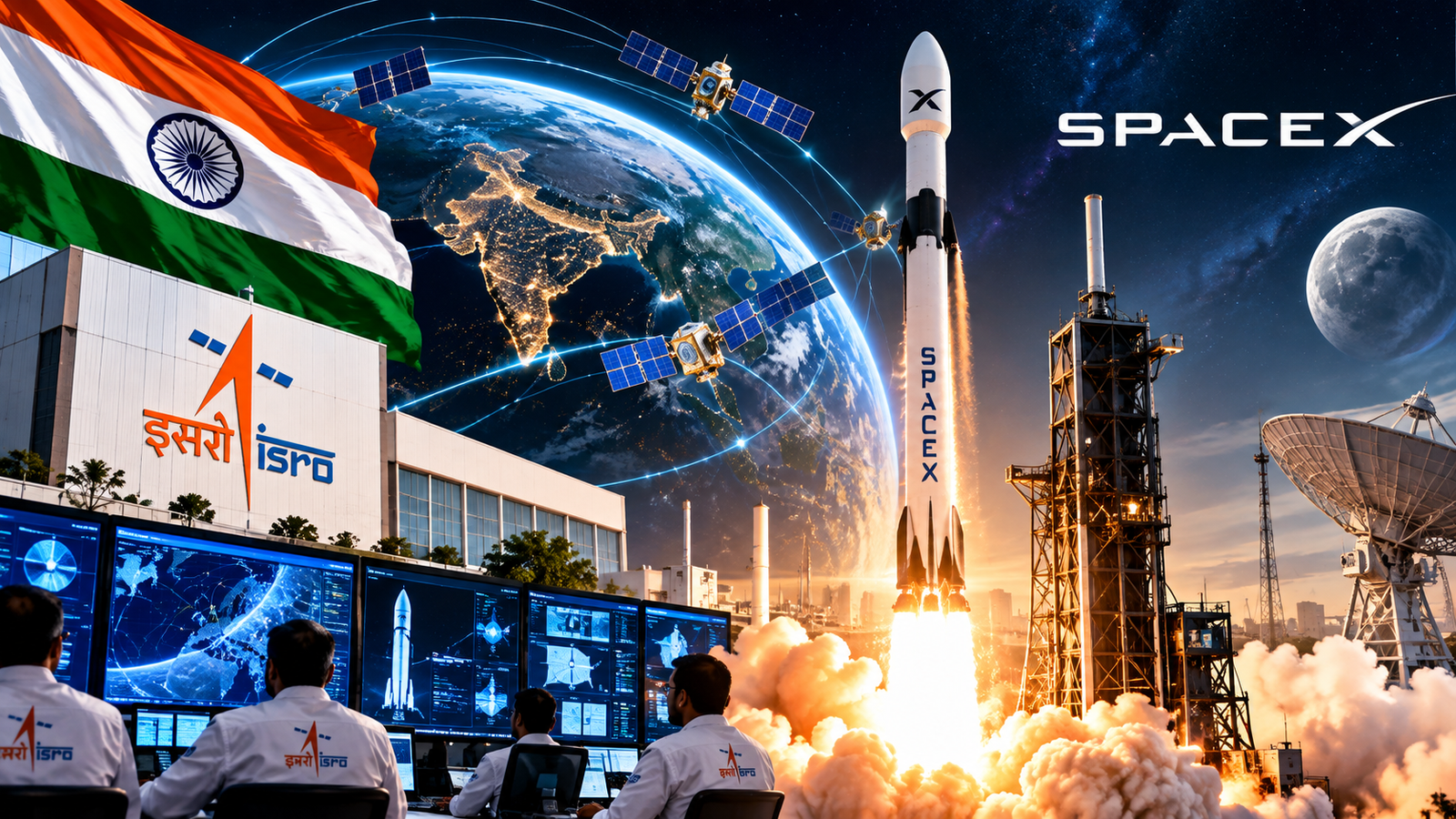
TakeMe2Space SpaceX launch: India’s Orbital Computing Push: TakeMe2Space Gears Up for SpaceX Launch
TakeMe2Space SpaceX launch: India is about to take a quiet but significant leap into the future of space technology. On October 1, 2026, a small Indian startup named TakeMe2Space will launch what it calls the country’s first orbital computing satellite aboard a SpaceX Falcon 9 rocket. This isn’t just another satellite beaming images back to Earth. It’s designed to think, process, and analyze data right there in orbit—potentially changing how we use space-based intelligence.
A Startup with Big Ambitions in a Small Satellite
TakeMe2Space, based in Hyderabad, has been working toward this moment since its first technology demonstrator, MOI-TD, flew in late 2024. That mission proved the company could upload software, run AI models in space, and send back results. Now, with MOI-1A, it’s moving from experiment to service.
The MOI-1A satellite weighs just 14 kg—smaller than many microwave ovens—but packs serious computing muscle. At its heart are Nvidia Orin NX processors, the same kind used in autonomous vehicles and robotics on Earth. These chips can deliver up to 117 trillion operations per second (TOPS), enough to run complex AI inference tasks while circling the planet at 27,000 km/
Unlike traditional satellites that capture raw data and downlink everything to ground stations, MOI-1A processes information onboard. Imagine a satellite flying over a forest fire: instead of sending gigabytes of raw imagery, it could instantly detect hotspots, map the fire’s spread, and transmit only the actionable alert. That means faster decisions and far less bandwidth wasted.
Why SpaceX? And What Happened to the ISRO Launch?
Originally, TakeMe2Space planned to launch MOI-1A on an Indian rocket. But after its predecessor, MOI-1, was lost in January 2026 when the third stage of ISRO’s PSLV-C62 failed, the startup needed a reliable ride—fast. “We took the first launch slot we could find on a SpaceX Falcon 9,” founder and CEO Ronak Samantray told ThePrint.
TakeMe2Space SpaceX launch: SpaceX’s Transporter-18 mission is a rideshare flight from Vandenberg Space Force Base in California, carrying dozens of small satellites from around the world. For startups like TakeMe2Space, it offers a cost-effective, high-frequency path to orbit. The Falcon 9 has become the workhorse of the small-sat revolution, and India’s private space firms are increasingly turning to it when domestic options face delays or setbacks.
Who’s Buying Space Computing?
TakeMe2Space SpaceX launch: TakeMe2Space isn’t building MOI-1A just to prove a point. It already has 23 paying customers signed up for this mission, including geographic information system (GIS) companies, educational institutions, and unnamed commercial clients. These customers will upload their own containerized AI models to the satellite before launch. Once in orbit, the satellite can process data as it passes over specific regions and send only the analyzed results back to Eartth.
TakeMe2Space SpaceX launch: This model turns the satellite into a kind of “cloud computer in the sky.” Instead of downloading terabytes of raw Earth observation data and processing it on the ground—a slow and expensive process—clients get instant insights. Applications could range from monitoring crop health and urban expansion to tracking maritime traffic or detecting illegal mining.
The company is also exploring orbital data storage as a service. Banks, financial firms, and defense clients could use space-based storage as a secure backup to terrestrial cloud providers, adding a layer of redundancy that’s literally out of this world.
Not a Data Center—Yet
TakeMe2Space SpaceX launch: TakeMe2Space SpaceX launch: It’s important to temper expectations: MOI-1A is not a full-blown orbital data center. With only about 150 watts of power and sub-50 kg mass, it’s best described as an edge-computing node. Think of it as a smart sensor with AI brains, not a server farm.
TakeMe2Space SpaceX launch: But this is just the beginning. TakeMe2Space has already outlined a roadmap for much larger satellites starting in 2027. By late 2028, the company plans to launch two 100-kg satellites on another SpaceX Falcon 9 mission (Waymaker-2) as part of its MOI constellation. Each of these will carry 10 Nvidia Thor GPUs and 100 TB of storage, enabling networked computing across multiple spacecraft. This mission, dubbed India’s first distributed orbital data center test, could lay the groundwork for a true space-based computing infrastructure.manufacturing.economictimes.
What This Means for India’s Space Ambitions
TakeMe2Space SpaceX launch: For decades, India’s space program has been dominated by ISRO, the government agency behind landmark missions like Chandrayaan and Mangalyaan. But the last few years have seen a surge in private space startups, fueled by policy reforms and growing investor interest. Companies like Skyroot Aerospace (which recently attempted India’s first private orbital rocket launch) and Pixxel (which just raised $100 million) are part of this new ecosystem
TakeMe2Space’s SpaceX launch signals that Indian startups are no longer just building hardware—they’re creating entirely new space-based services. Orbital computing sits at the intersection of AI, Earth observation, and cloud infrastructure, three of the fastest-growing tech sectors globally. If successful, MOI-1A could position India as an early player in this emerging market, alongside companies like Lonestar (US) and Orbital Edge (UK).
TakeMe2Space SpaceX launch: Moreover, the mission shows a pragmatic shift in India’s private space strategy: when domestic launch options are uncertain, go global. SpaceX’s reliability and frequent rideshare opportunities make it an attractive partner for time-sensitive missions. This doesn’t mean abandoning Indian rockets—it means ensuring missions fly, even if it means launching from California.
The Road Ahead: From Edge Node to Orbital Cloud
TakeMe2Space SpaceX launch: The MOI-1A launch is scheduled for October 1, 2026, with orbital injection expected by October 8 via a D-Orbit orbital transfer vehicle. Once in its sun-synchronous orbit at about 500 km altitude, the satellite will begin operations after a brief checkout phase.
TakeMe2Space SpaceX launch: Success here could unlock a cascade of opportunities. TakeMe2Space has talked about constellations of computing satellites working together, forming a mesh network that processes data across multiple orbits. Such a system could support real-time global monitoring for climate change, disaster response, or even national security.manufacturing.economictimes.indiatimes+1
Of course, challenges remain. Space is harsh: radiation, thermal extremes, and micrometeoroids can fry electronics. Computing in orbit also requires new software architectures and error-correction techniques. And while Nvidia chips are powerful, they weren’t originally designed for the space environment. TakeMe2Space will need to prove its systems can survive and perform over months or years, not just days.indianexpress+1
TakeMe2Space SpaceX launch: But if it works, the implications are profound. We may soon live in a world where critical data processing happens not in server farms in Virginia or Bengaluru, but in satellites whizzing overhead. India, through startups like TakeMe2Space, is positioning itself to be part of that future—not just as a launcher of rockets, but as a builder of the orbital cloud
Stay connected with the latest Indian News, World News, Breaking News, Latest Updates, Political News, Business & Stock Market, Sports, Technology & Digital, Entertainment, and Trending News with SACHKI KHABAR. Get fast, clear, and reliable updates on what is happening across India and around the world. Visit SACHKI KHABAR for the latest stories and important developments.
TIKVORA — Your trusted source for AI News, AI Tools, Technology, Startups, Innovation, Machine Learning, Generative AI, and Digital Trends. Fast, clear, and reliable updates on the technologies shaping the future.