Google AI powerhouse: A Birthday That Marks a Digital Revolution
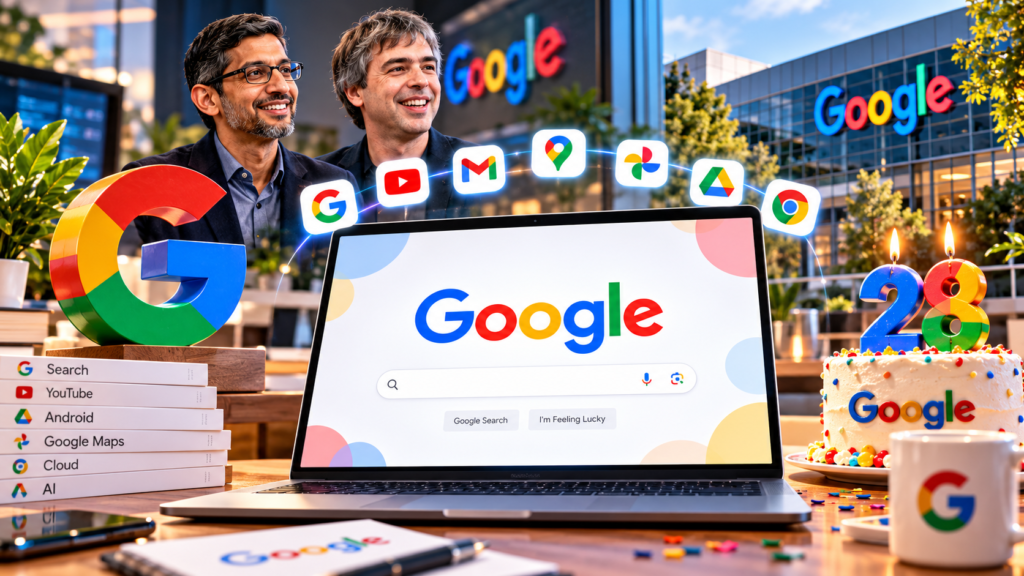
Google AI powerhouse: has turned 28, celebrating a journey that began with a simple idea: make information on the internet easier to find. On September 27, 2026, the company marked the occasion with a nostalgic Doodle inspired by its early logo. Although Google was officially incorporated on September 4, 1998, September 27 has become the date associated with its annual birthday celebration.
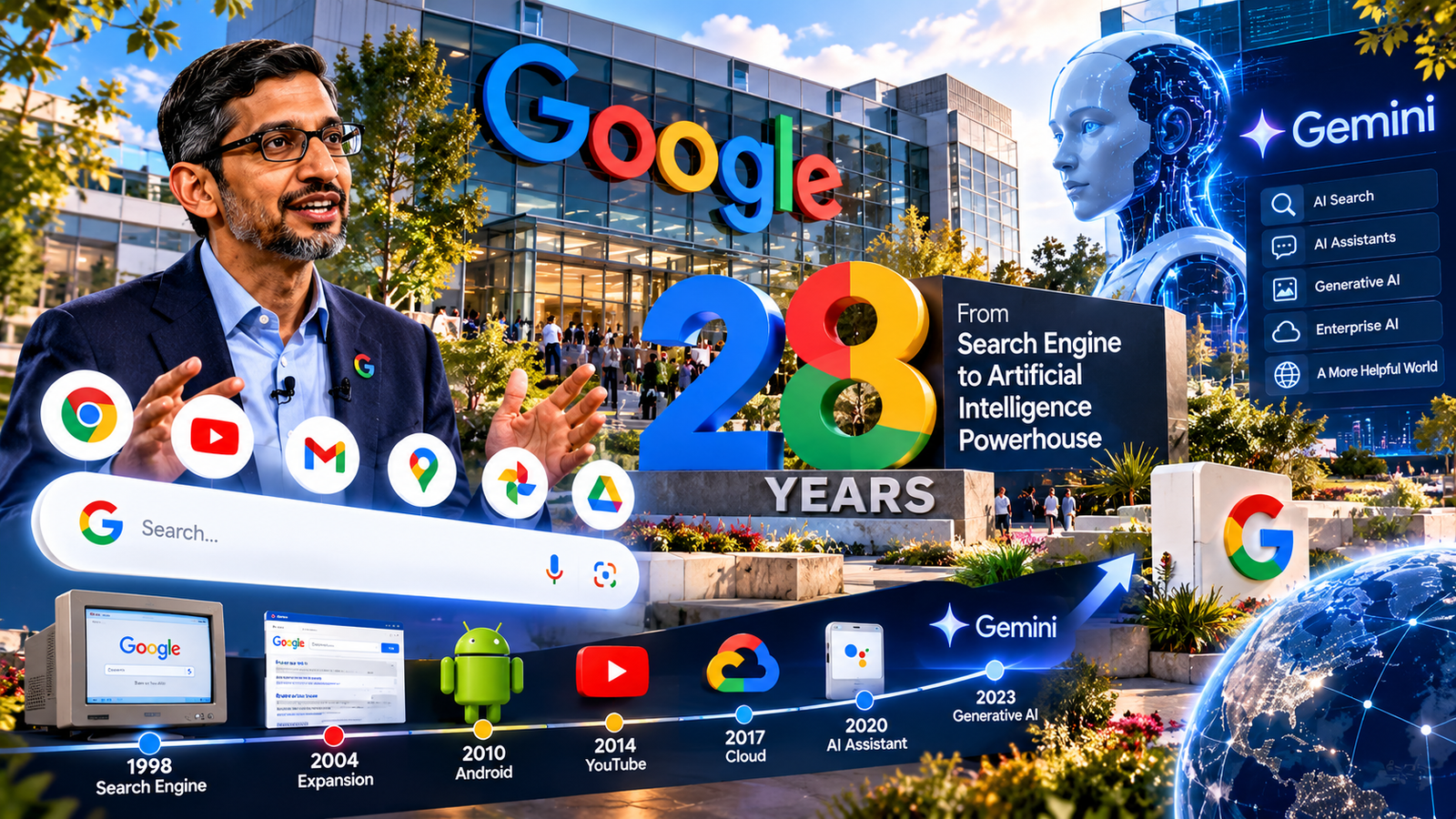
Google AI powerhouse: Over nearly three decades, Google has changed from a basic search engine into one of the world’s most influential technology companies. Its services now reach into almost every part of digital life, including email, maps, online video, smartphones, cloud computing, productivity software and artificial intelligence. The company’s story is not only about business growth; it is also about how the internet itself has changed.
The Stanford Beginning
Google AI powerhouse: origins go back to Stanford University, where Larry Page and Sergey Brin met in 1995. Both were studying computer science and became interested in the way information was organised across the rapidly growing World Wide Web. At that time, many search engines mainly examined the words on a webpage. Page and Brin believed that links between websites could provide another important clue about the value of a page.
Google AI powerhouse: Their early search project was called “BackRub.” It analysed links pointing to webpages and used those connections to estimate which pages were more useful or authoritative. This idea later developed into PageRank, the technology that helped Google deliver more relevant results than many competing search engines of the time.
The name Google came from “googol,” a mathematical term for the number one followed by 100 zeroes. The name reflected the founders’ ambition to organise an enormous amount of information. In 1998, Sun Microsystems co-founder Andy Bechtolsheim provided Page and Brin with an initial cheque of $100,000, helping them formalise the company and develop its early operations.
The Power of a Simple Search Box
Google AI powerhouse: early homepage looked remarkably different from many internet portals of the 1990s. Instead of filling the screen with news, advertisements and multiple menus, it offered a clean page with a logo and a search box. That simplicity became one of its greatest strengths.
Google AI powerhouse: Users could type a question or a few keywords and quickly receive a list of links. Google’s ranking system helped people find useful information without having to explore dozens of irrelevant pages. As internet use expanded, “Google it” became a common phrase in everyday language. Searching was no longer a specialised online activity; it became a normal part of studying, working, shopping and making decisions.
The company also developed a business model based largely on advertising. Search advertisements allowed Google to provide its main service free of charge while creating a powerful source of revenue. This model supported the company’s rapid expansion and helped finance new products.
Expansion Beyond Search
Google AI powerhouse: did not remain limited to web search. It built a broad ecosystem of services that became part of people’s daily routines. Gmail changed expectations for web-based email by offering large storage capacity and powerful search features. Google Maps made digital navigation more accessible, while YouTube became one of the world’s most important platforms for video and entertainment.
The company’s influence grew further through Android, its mobile operating system. Android helped bring smartphones to a wide range of users and allowed Google services to become part of mobile life. Chrome, Google Drive, Google Photos and Google Workspace extended the company’s presence into browsing, storage, communication and office work. Google also expanded into hardware through Pixel phones and other connected devices.thenews.
Google AI powerhouse: This expansion created a network effect. A person might use Google Search to find information, Maps to travel, Gmail to communicate, YouTube to watch videos and Drive to store documents. Each service had its own purpose, but together they formed a connected digital environment.
The Rise of Machine Learning
Artificial intelligence did not appear suddenly at Google. For years, the company used machine learning to improve search rankings, spelling suggestions, advertisements, translation and speech recognition. One important development was BERT, a language-understanding system that helped Google interpret the meaning and context of search queries more effectively.
Google AI powerhouse: This was a major change in how search worked. Earlier systems often focused on matching individual keywords. Machine-learning systems became better at understanding natural language, incomplete questions and the relationship between different words. This allowed users to search in a more conversational way.
Google AI powerhouse: research also influenced areas such as image recognition, healthcare research, robotics and scientific computing. The company invested in specialised hardware, including Tensor Processing Units, to support the large amount of computation required by modern AI models.
Gemini and the AI Era
Google AI powerhouse: most visible technological shift is its movement from traditional search toward generative artificial intelligence. The company’s Gemini model family is designed to work with multiple forms of information, including text, images, audio and video. Gemini can assist with reasoning, coding, writing and content creation.timesofindia.
This represents a different way of using technology. Traditional search generally provides a page of links and expects users to read, compare and form their own answer. Generative AI attempts to understand a request and produce a direct response. Instead of asking several separate questions, users may have a continuing conversation with an AI system.
Google AI powerhouse: is integrating AI into several of its products, including Search, Gmail, Docs, Maps and Android. In Search, AI features can help summarise information and connect different parts of a question. In productivity tools, AI can assist with drafting, organising information and analysing documents. These changes could save time, but they also raise important questions about accuracy, privacy and the future of online publishing.
Challenges in the New Competition
Google AI powerhouse: move into AI is taking place in a highly competitive technology industry. Companies such as Microsoft, OpenAI, Meta and many start-ups are also developing powerful AI systems. The competition is not only about creating better models; it is also about controlling the way people access information.
Google AI powerhouse: For Google, this is especially significant because search advertising remains central to its business. If people receive complete answers from AI systems, they may click fewer links and visit fewer websites. At the same time, AI-generated answers can sometimes contain incorrect or misleading information. Google therefore faces the difficult task of innovating quickly while maintaining the reliability that made its search engine successful.
The company must also respond to concerns about copyright, misinformation, data protection and the impact of AI on employment. Its future success will depend not only on technical performance, but also on whether users trust the systems it creates.
A New Chapter for Google
Google AI powerhouse: 28th birthday provides an opportunity to look back at a remarkable transformation. A research project called BackRub became a search engine used around the world. That search engine grew into a connected ecosystem covering communication, navigation, video, mobile technology and cloud services.
Now Google is entering another major phase. Its goal is no longer simply to organise webpages. It is increasingly trying to understand information, combine different types of data and help users complete tasks through artificial intelligence.
Google AI powerhouse: The next chapter may change how people search, learn and work. Yet the company’s original mission remains visible: making information useful and accessible. From a Stanford research project to Gemini and AI-powered services, Google’s 28-year journey shows how quickly technology can reshape everyday life. Its birthday is therefore more than a celebration of the past—it is a sign of how the future of the internet is already being built.
Grow your business online with SEO, Performance Marketing, Social Media Marketing, Website Development, Content Marketing, and Graphic Design & Branding services. Visit the DIGI SIKHO Digital Marketing Agency website to explore all our Digital Marketing Services.
TIKVORA — Your trusted source for AI News, AI Tools, Technology, Startups, Innovation, Machine Learning, Generative AI, and Digital Trends. Fast, clear, and reliable updates on the technologies shaping the future.
- Warning: 2026 Google September Spam Update Continues – 3 Badi Wajah & Outlook

- RBI MPC October 2026 5 7: Repo Rate in Focus as Inflation Risks Return

- 5 Best & Exclusive Reports: Jio Platforms IPO 21 October की संभावना!

- Amazon Great Indian Festival 2026 Begins on October 8: Major Discounts, Bank Offers and Festive Shopping Deals Announced

- iPhone 18 Pro Max network problems: What Indian Buyers Need to Know

- Incredible Arivihan $10 Million Funding: Kya Hai Wajah & 2026 Outlook