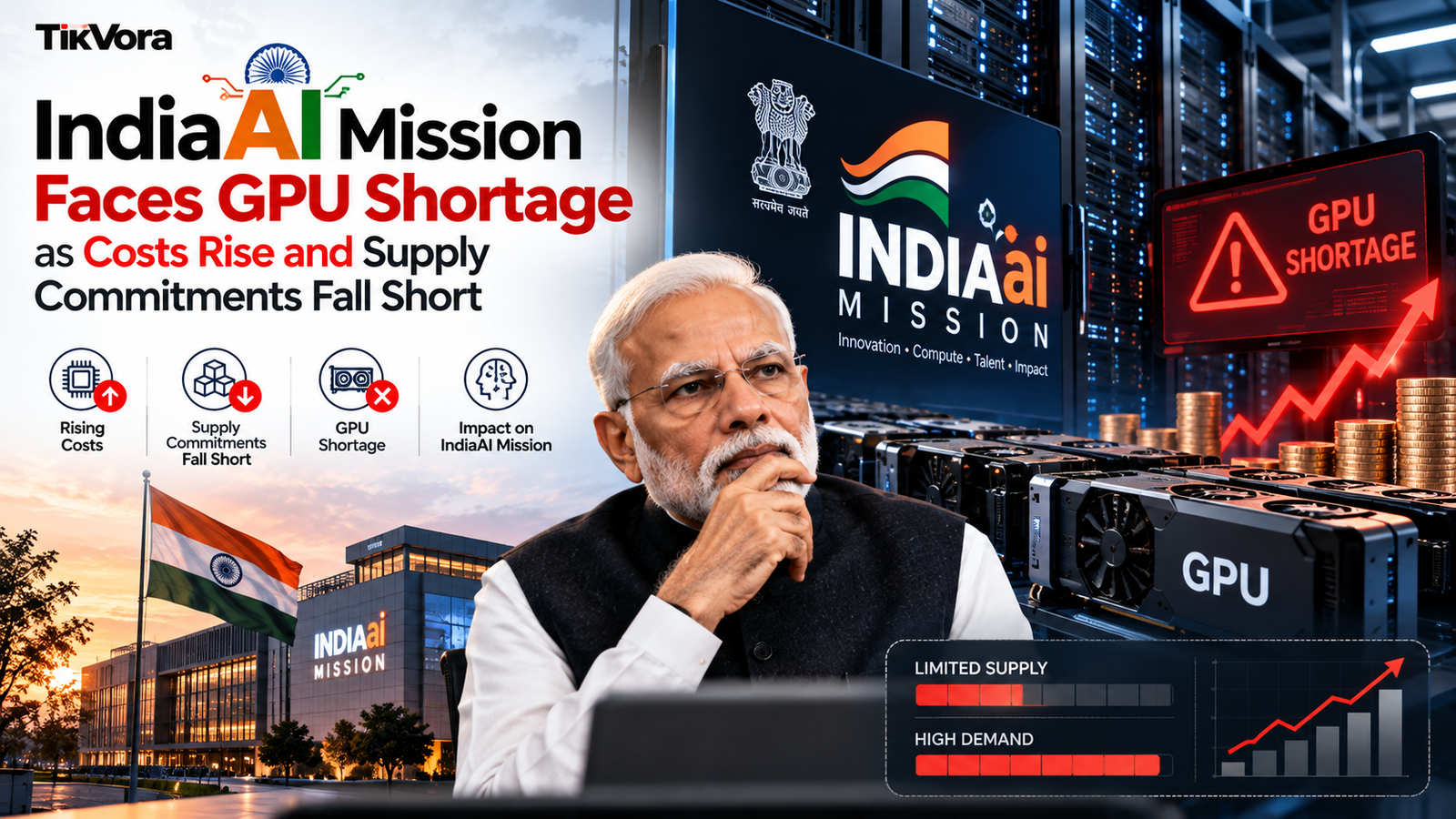
IndiaAI Mission GPU shortage: Ambition Meets a Global Hardware Crunch
IndiaAI Mission GPU shortage: ambition to build a strong and self-reliant artificial intelligence ecosystem is facing a major infrastructure challenge: a shortage of high-performance graphics processing units, or GPUs. These specialised chips are essential for training large language models, developing computer-vision systems, running voice-AI applications and powering advanced government services.
IndiaAI Mission GPU shortage: The issue has emerged at a critical moment for the IndiaAI Mission, the government’s flagship programme designed to expand access to AI computing for startups, researchers, universities and public institutions. The mission was approved in March 2024 with an outlay of approximately ₹10,372 crore over five years. Its central objective is to make expensive computing resources available at subsidised rates so that Indian organisations can develop AI solutions without depending entirely on foreign cloud providers.
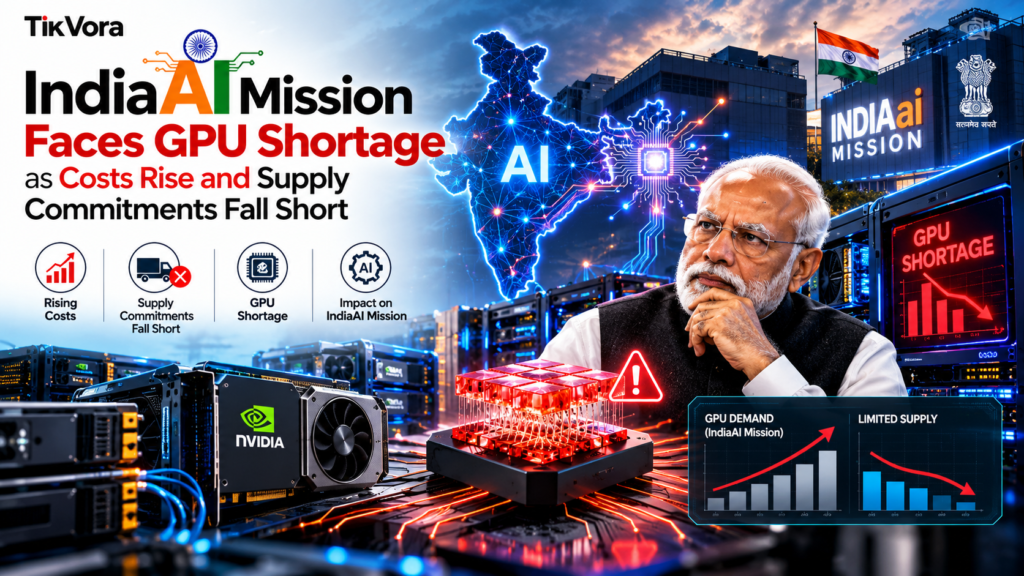
IndiaAI Mission GPU shortage: However, recent reports indicate that the mission is currently operating below its promised capacity. According to The Economic Times, IndiaAI has access to roughly 30,000 GPUs against a total commitment of about 45,000 units. Several companies that had promised to provide capacity have reportedly struggled to deliver because of rising hardware prices and limited global supply.
The gap between committed and usable GPUs is now forcing the government to reconsider its procurement strategy.
Why GPUs Matter to India’s AI Plans
IndiaAI Mission GPU shortage: were originally designed to process graphics and images, but their ability to perform thousands of calculations simultaneously has made them indispensable for modern AI. Training an advanced AI model requires processing enormous amounts of data repeatedly. A conventional central processing unit can perform these operations, but a GPU can complete many of them in parallel and reduce training time substantially.
IndiaAI Mission GPU shortage: For an Indian startup, access to a large GPU cluster can determine whether a new AI model is trained in weeks or months. It can also influence whether the company can compete with global firms that have access to billions of dollars in computing infrastructure.
IndiaAI Mission GPU shortage The IndiaAI Mission was created to reduce this disadvantage. Instead of forcing every startup or research institution to purchase expensive servers, the government has encouraged cloud and data-centre operators to make their GPUs available through a common platform. Approved users can apply for computing resources and receive subsidies that significantly reduce their effective cost.
IndiaAI Mission GPU shortage The government’s official IndiaAI portal says the programme is intended to serve academia, startups, small and medium-sized enterprises, researchers, government departments and public-sector organisations. The platform lists several types of hardware, including Nvidia H100 and H200 systems, AMD accelerators, Intel Gaudi processors and specialised cloud chips.
This model was designed to democratise AI. Yet the growing shortage of advanced chips is making that goal more difficult.
Supply Commitments Are Not Actual Capacity
IndiaAI Mission GPU shortage One of the biggest challenges is the difference between a company’s commitment and the number of GPUs that are physically installed, operational and available to users.
IndiaAI Mission GPU shortage In May 2025, the Ministry of Electronics and Information Technology said India’s common compute capacity had crossed 34,000 GPUs. The figure included 15,916 additional GPUs added to 18,417 previously empanelled units. The government described the expansion as an important step towards developing Indian foundation models and strengthening AI research.
IndiaAI Mission GPU shortage On paper, such numbers suggested rapid progress. In practice, however, not every committed GPU becomes immediately usable. Hardware may be delayed during procurement, installation or testing. Some machines may remain unavailable because of networking limitations, data-centre capacity, power requirements or software compatibility issues.
The Economic Times reported that the government currently has access to about 30,000 GPUs, while the larger commitment is approximately 45,000. The difference shows why headline figures must be examined carefully. A GPU may be listed in a procurement commitment, but that does not necessarily mean a startup can log in and use it immediately.
IndiaAI Mission GPU shortage This distinction matters for researchers working on fixed deadlines. If a project receives approval but the assigned hardware is delayed, training schedules can be disrupted. In AI development, even a short delay can increase costs because teams may need to retain engineers, postpone product launches or continue paying for alternative cloud services.
Hardware Prices Have Changed Dramatically
IndiaAI Mission GPU shortage The global AI hardware market has become considerably more expensive since the IndiaAI Mission was launched. Demand for advanced chips has grown rapidly as technology companies, cloud providers and governments compete to build AI data centres.
The shortage is not limited to GPUs alone. AI servers also require high-bandwidth memory, advanced networking equipment, storage systems, cooling infrastructure and reliable power supplies. When the price of any one of these components rises, the cost of deploying a complete GPU cluster increases.
IndiaAI Mission GPU shortage The Economic Times reported that the price of Nvidia’s H200 GPU had risen from approximately $20,000 to more than $40,000. It also reported that a server that previously cost around ₹2 crore could now cost close to ₹4 crore. Industry executives cited shortages of memory and other server components, currency movements and uncertainty about future demand as factors affecting procurement.
These increases create a difficult situation for cloud-service providers. Companies that offered GPU capacity during an earlier tender may have based their prices on conditions that no longer exist. If the cost of acquiring and operating the equipment rises sharply, providers may find it financially difficult to honour old commitments at the same rates.
That may explain why some firms have reportedly delivered only part of their promised capacity.
Government Plans New Bids and Direct Procurement
IndiaAI Mission GPU shortage The government is now considering several measures to reduce the impact of the shortage. One approach is to issue fresh bids and invite additional companies to provide GPU capacity. Another is to press existing empanelled providers to fulfil their commitments.
A more significant change is the government’s reported decision to purchase GPUs directly. The Ministry of Electronics and Information Technology is planning to acquire approximately 3,000 GPUs through the Centre for Development of Advanced Computing, or C-DAC. Some of this capacity is expected to be used by government departments, while the remaining resources may be offered to startups and researchers.
IndiaAI Mission GPU shortage This represents a shift from the earlier strategy of relying mainly on private companies to supply computing capacity. Direct ownership could give the government greater control over availability, pricing and allocation. It could also provide a backup when private providers cannot deliver equipment on schedule.
However, government ownership brings its own responsibilities. Hardware must be maintained, upgraded and efficiently allocated. AI chips become outdated quickly, so a system purchased today may need expansion or replacement within a few years. The government will also need technical teams to manage large-scale clusters and ensure that researchers can use them effectively.
Subsidised Access Is Important but Not Enough
The IndiaAI Mission has helped bring down the cost of AI computing for eligible users. Earlier government communications said common compute resources would be available at significantly reduced rates. The official portal also shows that organisations have been allocated different types and quantities of GPUs for projects in areas such as language technology, agriculture, public services and cybersecurity.
IndiaAI Mission GPU shortage But cheaper access does not solve the shortage if demand is greater than supply. A startup may be able to afford a subsidised GPU hour but still fail to obtain enough computing time for a large training project.
This is especially important for foundation models, which require large clusters operating continuously for extended periods. A small interruption can slow down training and increase expenses. Research institutions may face similar difficulties when they have to share limited resources among multiple teams.IndiaAI Mission GPU shortage
The challenge is therefore not only the number of GPUs. India also needs efficient scheduling, transparent allocation rules, strong networking, data-storage systems and technical support. A large number of disconnected or underused GPUs would not deliver the same benefits as a smaller but well-managed national computing platform.IndiaAI Mission GPU shortage
Impact on Startups and Researchers
Indian startups are likely to feel the effects of the shortage most directly. Large global technology companies can often negotiate long-term agreements with cloud providers or purchase hardware in bulk. Early-stage Indian companies usually lack that financial strength.
If subsidised GPUs are delayed, startups may have to choose between reducing the size of their models, postponing product development or paying commercial cloud prices. For a young company with limited funding, these costs can affect hiring, research and survival.
Researchers could also face delays in projects involving Indian languages, medical imaging, climate analysis, agriculture and public administration. India’s AI strategy depends heavily on models that understand local languages, social conditions and government requirements. Such work requires access to both data and computing power.
The shortage could also affect India’s goal of developing indigenous foundation models. In May 2025, the government announced additional support for startups working on large multilingual, voice and open-source models. These projects require substantial computational resources during both training and testing.
The Need for a Longer-Term Strategy
The immediate procurement problem highlights a broader question: should India rely on short-term GPU tenders, or should it build a sustained national AI infrastructure policy?
A long-term strategy would combine several approaches. The government could own a core pool of high-end GPUs, contract additional capacity from private providers and support domestic data-centre construction. It could also encourage the use of different accelerator technologies rather than depending too heavily on a single chip supplier.
Software optimisation is another important part of the solution. Smaller, more efficient models can reduce the amount of computing required. Techniques such as quantisation, model distillation, parameter-efficient training and better data selection can help organisations achieve useful results with fewer GPUs.
India also needs to develop skills in cluster management, chip design, AI infrastructure and energy-efficient computing. Building or renting hardware is only one part of creating a competitive AI ecosystem.
A Test of India’s AI Credibility
The GPU shortage does not mean that the IndiaAI Mission has failed. The programme has already created a national framework for subsidised AI computing and attracted private-sector participation. Official figures show that India’s planned and empanelled capacity has grown significantly from the initial target of 10,000 GPUs.
Nevertheless, the current difficulties expose the risks of announcing large capacity targets before the supply chain is fully secured. India’s AI ambitions will depend not only on public spending but also on reliable delivery, transparent reporting and realistic timelines.
IndiaAI Mission GPU shortage: The government’s next steps will be closely watched by startups, universities and technology companies. If new bids are completed quickly and direct procurement is managed effectively, the present shortage could become an opportunity to build a more resilient national compute network.
For now, the central lesson is clear: access to AI is no longer determined only by talent, data or algorithms. It is also determined by access to powerful and dependable hardware. India has made progress in expanding that access, but the global GPU shortage shows that the country must move from headline commitments to operational capacity.
The success of the IndiaAI Mission will ultimately be measured not by the number of GPUs announced, but by how many researchers, startups and public institutions can use them when they need them.
TIKVORA — Your trusted source for AI News, AI Tools, Technology, Startups, Innovation, Machine Learning, Generative AI, and Digital Trends. Fast, clear, and reliable updates on the technologies shaping the future.
Stay connected with the latest Indian News, World News, Breaking News, Latest Updates, Political News, Business & Stock Market, Sports, Technology & Digital, Entertainment, and Trending News with SACHKI KHABAR. Get fast, clear, and reliable updates on what is happening across India and around the world. Visit SACHKI KHABAR for the latest stories and important developments.