October 2026 UPI banking rules: Introduction: Why October Matters for Bank Customers
October 2026 UPI banking rules: is bringing several important changes to India’s banking and digital-payment system. These changes will affect UPI merchants, bank customers, fixed-deposit investors, ATM users, LPG consumers and some taxpayers. While many headlines suggest that UPI payments will become chargeable, the actual position is more limited: the proposed Merchant Discount Rate, or MDR, will apply only to selected merchant transactions above ₹2,000, while person-to-person UPI transfers will continue to remain free.
October 2026 UPI banking rules: The changes are being introduced in stages. Some rules will apply from October 1, while the new UPI MDR framework is scheduled to begin from October 15, 2026. Customers should understand the difference between a direct customer fee and a charge within the merchant-payment ecosystem before changing the way they use UPI.
New UPI MDR Rules From October 15
October 2026 UPI banking rules: One of the biggest announcements concerns UPI merchant payments. From October 15, 2026, an MDR of 0.4% will apply to certain eligible person-to-merchant, or P2M, UPI transactions above ₹2,000. MDR is the fee paid within the payment ecosystem for processing a merchant transaction. It is generally settled among participants such as the acquiring bank, issuing bank, payment service provider and payment network.
This does not mean that every person making a UPI payment will automatically have to pay a separate charge. According to reports, person-to-person transactions will continue to remain free, regardless of the amount transferred. Payments made to small merchants under the zero-MDR framework will also remain exempt.
October 2026 UPI banking rules: For example, if a customer sends ₹5,000 to a friend through UPI, the transfer will remain a person-to-person transaction and will not attract this MDR. If the customer pays a large merchant ₹5,000, the merchant transaction may fall under the new framework. The exact impact will depend on the category of merchant, transaction type and applicable eligibility conditions.
Payments Below ₹2,000 to Remain Free
October 2026 UPI banking rules: UPI payments to merchants up to ₹2,000 are expected to remain free under the revised structure. This is important because a large share of everyday digital payments involves small-value purchases such as groceries, local transport, snacks, medicines and household items.
October 2026 UPI banking rules: Reports also indicate that most person-to-merchant transactions will remain unaffected. The Economic Times has reported that approximately 96% of P2M transactions may continue outside the new charge structure. This means that the change is not a blanket fee on UPI and should not be described as the end of free UPI payments.
However, merchants should closely review the notifications issued by their banks and payment providers. They should check whether their business category, turnover, monthly transaction value and payment instruments fall within the eligible MDR framework. Businesses should also examine their settlement statements to understand whether any applicable charge is being deducted from their receipts.
What UPI Users Need to Check
Customers should not assume that every payment above ₹2,000 will carry a fee. The proposed change is based on the nature of the transaction and the merchant category, not simply the amount. A payment to a friend, family member or another individual will remain different from a payment made to a registered merchant.
Users should also be careful about fake messages claiming that UPI has become chargeable for everyone. Fraudsters may use the news to send links requesting “UPI activation fees”, “MDR refunds” or “account verification payments”. Banks and payment apps normally do not ask users to share their UPI PIN, card PIN or one-time password to receive a refund.
The safest practices remain simple:
- Never share a UPI PIN with anyone.
- Do not approve a collect request unless the purpose is clear.
- Check the recipient’s name before confirming a payment.
- Avoid clicking on links received through unknown messages.
- Contact the bank or payment application through its official support channel if a charge appears unexpectedly.
RBI Rules for Bulk Fixed Deposits
October 2026 UPI banking rules: The Reserve Bank of India is also changing the way banks disclose interest rates on bulk fixed deposits. These revised requirements are scheduled to take effect from October 1, 2026. Under the new framework, banks will need to disclose bulk-deposit rates in advance and publish the applicable rates regularly, including a daily disclosure at 10 a.m., according to reports.
October 2026 UPI banking rules: The purpose is to improve transparency for large depositors. Bulk fixed deposits are generally associated with high-value deposits made by companies, institutions, trusts and other large customers. Previously, deposit rates could be influenced by negotiations or internal pricing practices. The updated disclosure system is intended to make the process more predictable.
Another reported requirement is that banks should offer the same interest rate across branches for deposits of the same amount and tenure booked on the same day. This could reduce differences between branches and make it easier for depositors to compare offers.
October 2026 UPI banking rules: Retail customers may not notice a direct change in their regular fixed deposits. Nevertheless, the new approach could improve overall transparency in the deposit market. Customers investing large amounts should compare the rate, tenure, premature-withdrawal conditions, tax treatment and deposit-insurance limits before booking an FD.
SBI ATM Free Transaction Limits
Some State Bank of India salary-package account holders may face revised limits on free transactions at other banks’ ATMs from October 1, 2026. Reports indicate that the free limit for certain salary-account variants may be reduced from 10 transactions to five transactions per month.
October 2026 UPI banking rules: The change is relevant mainly to customers who frequently use other banks’ ATMs. Once the applicable free limit is exhausted, the bank may impose charges according to the account’s terms and prevailing regulatory requirements. The exact benefit can vary depending on the salary-package variant and the type of ATM transaction.
October 2026 UPI banking rules: Customers should distinguish between financial transactions, such as cash withdrawals, and non-financial transactions, such as balance enquiries or mini statements. They should also check whether transactions at SBI ATMs, other bank ATMs and cash recyclers are counted differently.
To avoid unnecessary charges, customers can use digital banking for balance checks and select the nearest authorised ATM carefully. It is also useful to review the monthly account statement because ATM charges may not always be noticed immediately.
LPG Aadhaar Authentication and Subsidy
Another change concerns biometric Aadhaar authentication for domestic LPG consumers. Reports say that customers who have not completed the required authentication may need to do so to book a refill at the regulated selling price and receive the applicable subsidy.
October 2026 UPI banking rules: The requirement is intended to ensure that subsidised LPG benefits reach eligible beneficiaries. Consumers should complete the process only through authorised channels, such as their LPG distributor, official oil-company application or government-supported service centre.
Customers should be cautious about sharing Aadhaar details with unknown callers or agents. No one should share an OTP, banking password or UPI PIN during an Aadhaar-authentication process. If a consumer is unsure about the status of authentication, the best option is to check directly with the official LPG provider.
Changes for Exporters and Importers
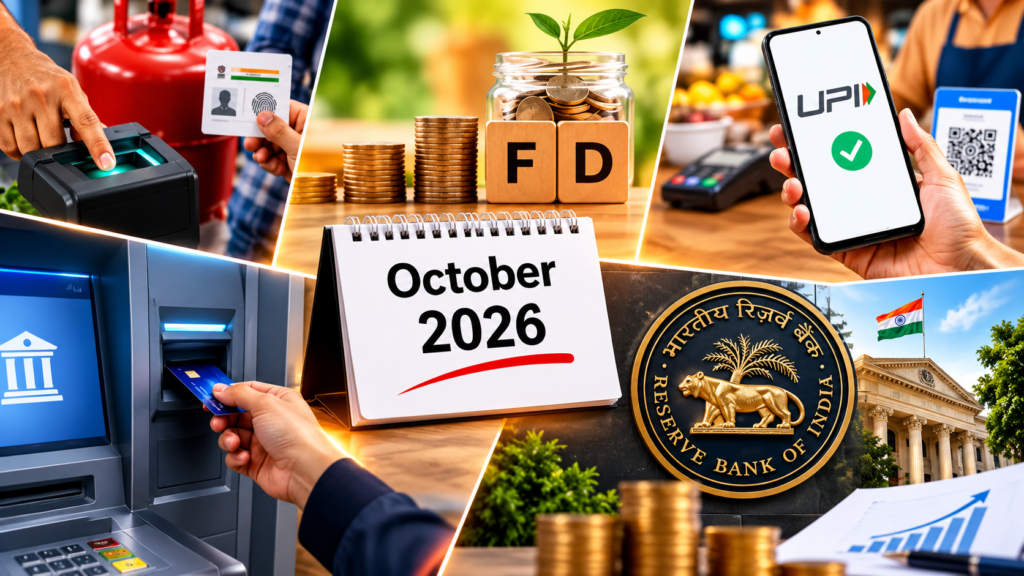
October 2026 UPI banking rules: The Reserve Bank of India has also revised certain rules relating to foreign-exchange transactions under FEMA. For exports invoiced or settled in Indian rupees, the deadline for realisation and repatriation has reportedly been reduced from 18 months to 12 months.
This change may be more relevant to exporters, importers, authorised dealer banks and companies involved in international trade than to ordinary retail customers. Businesses handling cross-border transactions should speak with their bank’s foreign-exchange department and review their documentation, payment schedules and outstanding receivables.
October 2026 UPI banking rules: Failure to monitor the revised timelines could create compliance difficulties. Exporters should maintain proper records of invoices, shipping documents, inward remittances and settlement dates. Importers should also verify whether their payment arrangements comply with the updated framework.
What Consumers Should Do This Month
The October changes do not require every bank customer to take immediate action. However, a short review can help prevent confusion and unexpected charges.
October 2026 UPI banking rules: First, UPI users should continue using the service normally but examine transaction descriptions and receipts. A payment between individuals should not be confused with a merchant payment. Second, customers with SBI salary accounts should check their ATM transaction limits and account-specific schedule of charges. Third, large FD investors should compare the rates and disclosure practices of different banks before making a deposit.
LPG consumers should verify Aadhaar-authentication status through official channels. Business owners should contact their acquiring bank or payment service provider to understand whether the new MDR framework applies to their transactions. Exporters and importers should review the revised FEMA timelines with professional or banking support.
October 2026 UPI banking rules: Conclusion: UPI Is Not Becoming Fully Chargeable
The most important point is that UPI is not becoming chargeable for everyone from October 2026. The reported MDR framework will apply only to selected merchant transactions above ₹2,000 from October 15. Person-to-person payments, smaller merchant payments and transactions covered under the zero-MDR framework are expected to remain free.
At the same time, the changes to bulk-FD disclosures, ATM limits, LPG authentication and foreign-exchange timelines show that customers and businesses should pay attention to account-specific rules. Reading official bank messages, checking statements and avoiding unverified social-media claims will be more useful than reacting to alarming headlines. As India’s digital-payment system expands, understanding the difference between a merchant-side processing charge and a direct customer fee will become increasingly important.
Stay connected with the latest Indian News, World News, Breaking News, Latest Updates, Political News, Business & Stock Market, Sports, Technology & Digital, Entertainment, and Trending News with SACHKI KHABAR. Get fast, clear, and reliable updates on what is happening across India and around the world. Visit SACHKI KHABAR for the latest stories and important developments.
TIKVORA — Your trusted source for AI News, AI Tools, Technology, Startups, Innovation, Machine Learning, Generative AI, and Digital Trends. Fast, clear, and reliable updates on the technologies shaping the future.