
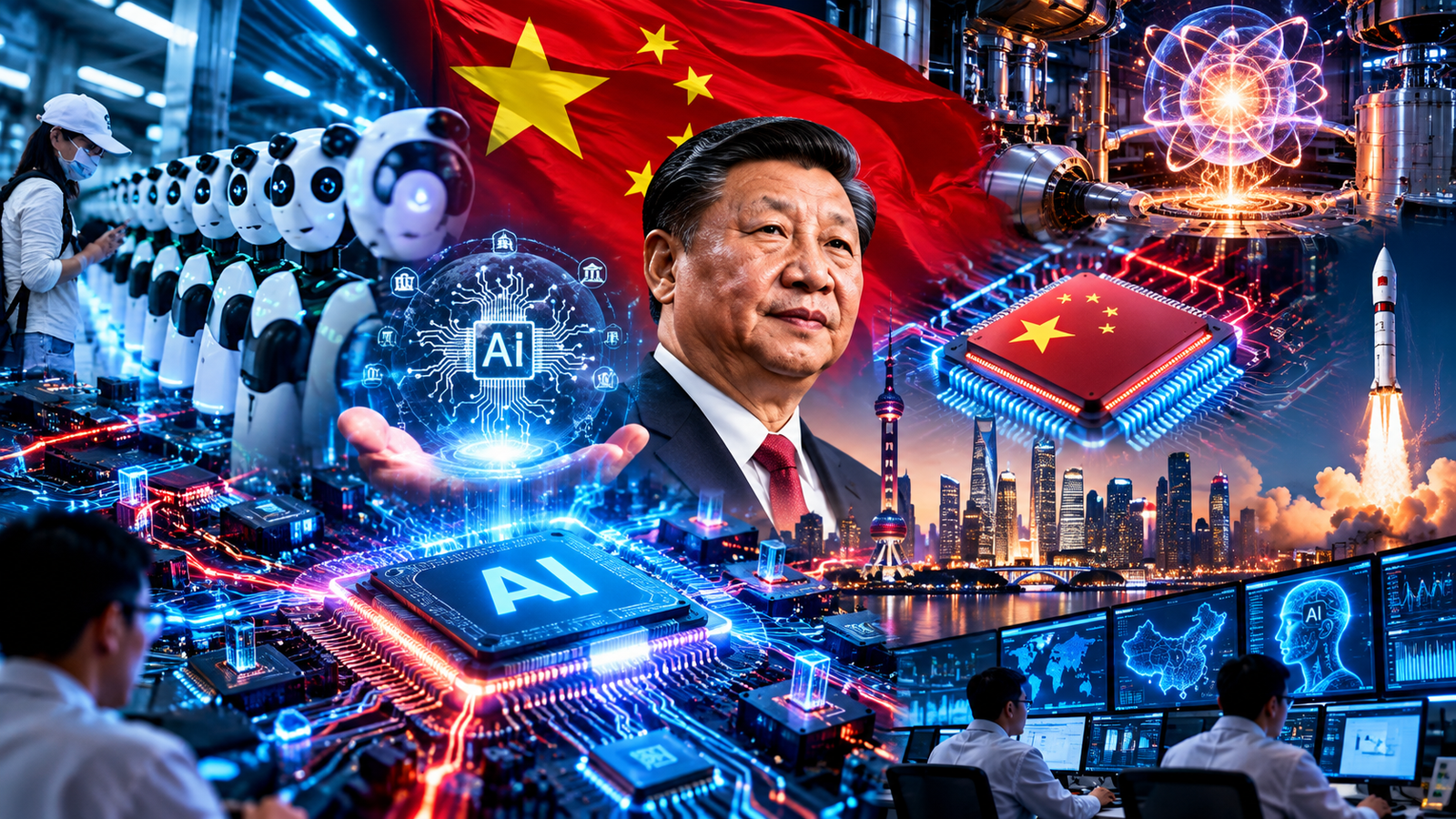
China new tech strategy: A broader vision for technological self-reliance
China new tech strategy: China’s latest technology strategy shows that Beijing is no longer treating artificial intelligence as a stand-alone race. Under the 2026–2030 development agenda, AI is being placed alongside advanced semiconductors, quantum technology, controlled nuclear fusion, biotechnology, robotics and brain-computer interfaces. The goal is to build a complete scientific and industrial ecosystem that can reduce China’s dependence on foreign technology and strengthen its position in the global technology competition.business-standard+1
The strategy is connected to China’s 15th Five-Year Plan, which covers the period from 2026 to 2030. It gives special importance to basic research, domestic innovation and the faster transfer of laboratory discoveries into commercial products. China’s research authorities have also called for stronger cooperation between universities, state laboratories, technology companies and manufacturers.
China new tech strategy: This approach reflects a major change in the nature of the technology race. Instead of concentrating only on popular AI applications, China is investing in the deeper foundations required to power future industries. These foundations include advanced chips, high-performance computing, new materials, secure communications and clean energy.
AI as the central engine
AI remains the most visible part of China’s technology programme. The government plans to expand its “AI Plus” initiative, which aims to introduce artificial intelligence into manufacturing, finance, healthcare, transport, education and scientific research. The strategy also mentions multimodal AI, intelligent agents, embodied AI and swarm intelligence.
China new tech strategy: Multimodal systems can work with several types of information, such as text, images, audio and video. AI agents are designed to complete tasks with less human supervision, while embodied AI refers to intelligent systems built into robots and machines. These technologies could help China modernise factories, improve logistics and develop humanoid robots for industrial and domestic use.
China also wants AI to become a tool for scientific discovery. AI systems may be used to analyse large research datasets, simulate materials, identify new medicines and support experiments in physics and biology. The Chinese Academy of Sciences has made “intelligent scientist systems” and AI-supported research important areas in its new plan.
However, China’s objective is not simply to produce another successful chatbot. The larger ambition is to embed AI across the economy and connect it with hardware, energy, industry and national research projects.
Chips and the struggle for independence
Semiconductors are one of the most important parts of the new strategy. Modern chips are essential for smartphones, electric vehicles, data centres, military systems, satellites and AI applications. China has made major progress in chip design and manufacturing, but it still faces restrictions on access to some advanced semiconductor equipment, software and technologies.
China new tech strategy: For this reason, Beijing is focusing on the entire chip supply chain. Its priorities include chip design, manufacturing equipment, industrial software, high-end instruments, advanced materials and packaging technologies. The strategy calls for breakthroughs across the “whole chain of development,” rather than relying on a single company or one specific chip-generation target.
High-performance AI chips are particularly important. Training and operating large AI models require enormous computing power. If access to foreign processors becomes more limited, Chinese companies will need domestic alternatives that are efficient, reliable and available at scale.
China new tech strategy: Building this capability will not be easy. Semiconductor manufacturing depends on highly specialised machines, advanced chemicals, precision engineering and years of technical experience. China’s plan therefore combines government funding, research support, industrial policy and collaboration with private technology companies.
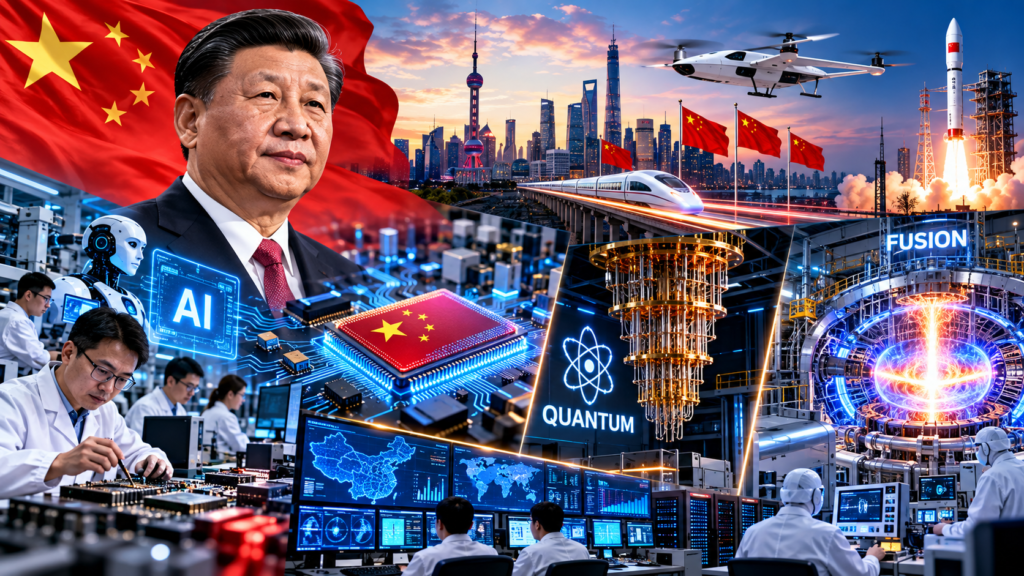
Quantum technology and secure communication
China new tech strategy: Quantum technology is another major pillar of China’s long-term strategy. Quantum computers use principles of quantum physics to process certain problems in ways that may be very different from conventional computers. Although practical, large-scale quantum computing is still at an early stage, governments see it as strategically important because it could influence cybersecurity, scientific modelling, logistics and drug discovery.
China’s plans include the development of general-purpose quantum computers, scalable specialised quantum systems and high-precision quantum measurement. The country is also interested in building integrated quantum communication networks linking ground stations and space-based systems.
China new tech strategy: Quantum communication may eventually provide highly secure methods of transmitting information. Quantum sensors could support navigation, geological exploration and scientific measurement. At the same time, the technology presents serious challenges, including error correction, fragile quantum states and the difficulty of building systems that can operate reliably at scale.
China’s investment in this area demonstrates that the country is planning for technologies that may become commercially important many years from now, not only those that can generate immediate economic returns.
Nuclear fusion and the future of energy
China new tech strategy: Controlled nuclear fusion has also been identified as a strategic research priority. Fusion attempts to reproduce the process that powers the sun, using extreme temperatures and pressure to combine light atomic nuclei and release energy. If engineers can make fusion commercially practical, it could provide a large source of low-carbon electricity.
China new tech strategy: technology blueprint calls for key breakthroughs in controlled nuclear fusion. Researchers are working on reactor designs, plasma control, superconducting magnets, advanced materials and methods for maintaining stable fusion reactions.
Fusion is one of the most difficult scientific challenges in the world. Producing a fusion reaction is not the same as building a reliable power station. A commercial reactor would need to generate more energy than it consumes, operate for long periods and withstand intense heat and radiation.
China new tech strategy: China’s interest in fusion is linked to energy security as well as scientific prestige. A successful fusion programme could support long-term economic growth, reduce pressure on fossil fuels and provide a technological advantage in advanced energy systems.
One connected national system
China new tech strategy: The most significant feature of China’s strategy is the way these technologies are being connected. AI can assist chip design, improve fusion simulations and analyse quantum experiments. Advanced chips provide the computing power needed for AI and scientific modelling. Quantum sensors may support energy and navigation systems, while new materials can benefit semiconductors, robotics and fusion reactors.
This “whole-of-nation” model brings together public research institutions, universities, state-owned companies and private technology firms. China is also placing greater emphasis on scientific talent, interdisciplinary research and the movement of discoveries from laboratories into factories.
China new tech strategy: The strategy nevertheless faces obstacles. Some projects may require decades of research before they produce commercial results. Domestic companies must overcome shortages of specialised equipment, experienced engineers and advanced manufacturing tools. There is also a risk that excessive government direction could lead to duplicated projects or inefficient investment.
China new tech strategy: Global consequences
China’s approach will intensify competition with the United States, Europe, Japan, South Korea and other technology powers. The contest will involve more than AI models. It will also include access to chips, manufacturing equipment, critical minerals, research talent, energy technologies and secure data systems.
China new tech strategy: For other countries, China’s strategy could bring both opportunities and risks. Faster progress in AI, robotics, clean energy and quantum science may create new products and scientific partnerships. At the same time, increasing technological rivalry could lead to stricter export controls, fragmented supply chains and separate technology standards.
China’s new plan therefore represents a long-term effort to control the foundations of future growth. AI is at the centre, but chips, quantum technology and fusion give the strategy its wider meaning. Beijing is preparing not only for the next generation of software, but also for the hardware, energy and scientific capabilities that may determine global power in the decades ahead.
Stay connected with the latest Indian News, World News, Breaking News, Latest Updates, Political News, Business & Stock Market, Sports, Technology & Digital, Entertainment, and Trending News with SACHKI KHABAR. Get fast, clear, and reliable updates on what is happening across India and around the world. Visit SACHKI KHABAR for the latest stories and important developments.
TIKVORA — Your trusted source for AI News, AI Tools, Technology, Startups, Innovation, Machine Learning, Generative AI, and Digital Trends. Fast, clear, and reliable updates on the technologies shaping the future.