Listed startups VC PE investors: Secondary Share Sales Create a New Exit Route
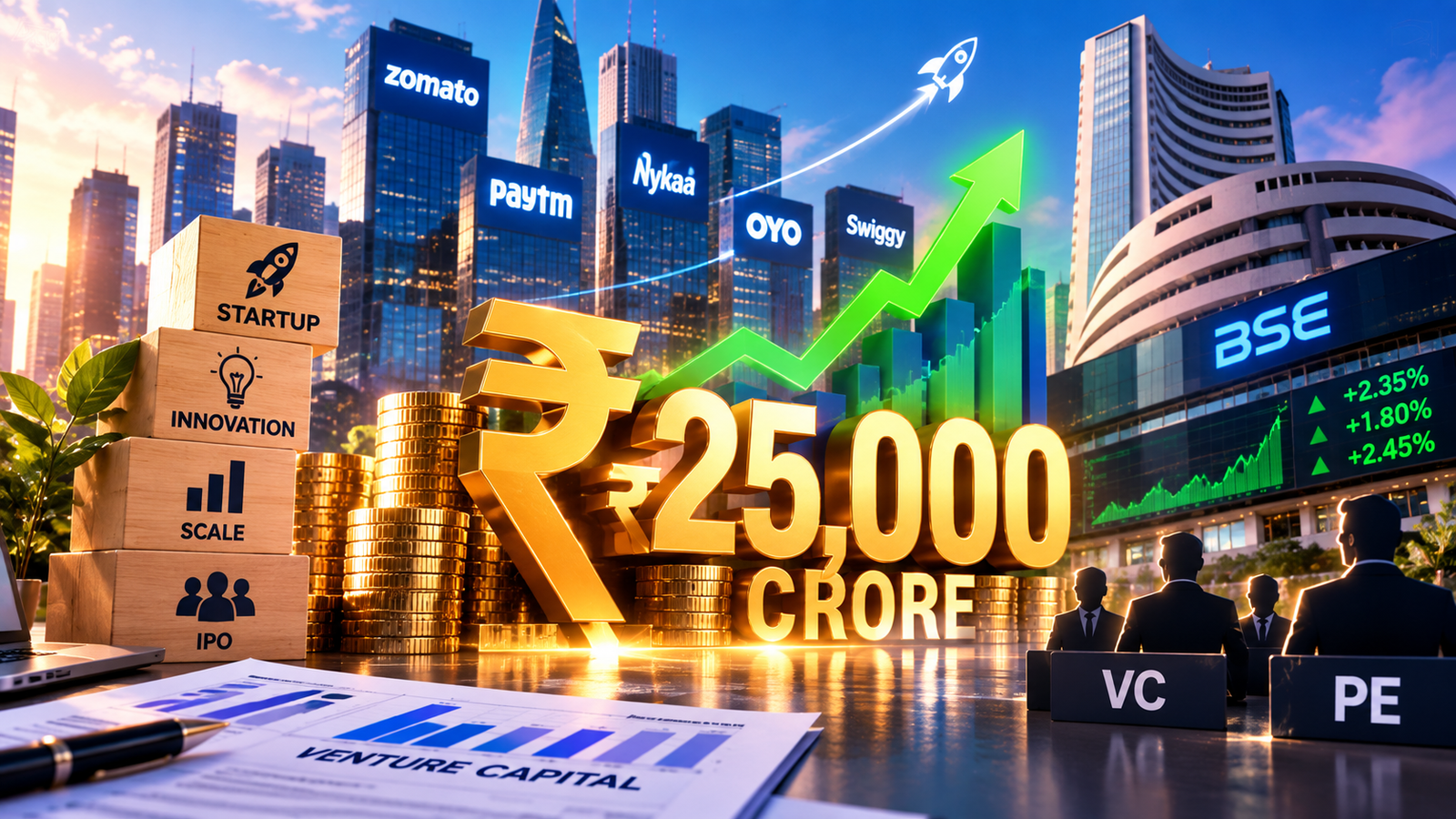
₹25,000 crore India’s listed startup ecosystem has delivered a major liquidity opportunity for venture capital and private equity investors. During the July–September quarter, investors reportedly realised nearly ₹25,000 crore by selling shares in 18 new-age companies through block and bulk deals on the National Stock Exchange and Bombay Stock Exchange. The transactions included stake sales by global investors such as SoftBank and prominent Indian venture capital firms including Peak XV Partners, Elevation Capital and Accel.
Listed startups VC PE investors The development is significant because it shows that India’s startup market is gradually moving beyond the traditional funding-and-growth cycle. For several years, investors placed large amounts of capital into technology companies, fintech platforms, consumer brands and internet businesses. Their ultimate challenge, however, was finding a reliable way to convert those paper gains into actual returns.
Public listings have now made that process easier. Once a startup is listed, early investors can sell part of their holdings in the open market or through negotiated block transactions, subject to applicable regulations and lock-in conditions. This gives them an opportunity to return money to the institutions and individuals who invested in their funds.Listed startups VC PE investors
SoftBank Leads Investor Realisation
Japan’s SoftBank Vision Fund II was among the most prominent sellers during the quarter. According to the reported analysis, SoftBank realised approximately ₹4,538 crore through stake sales in Lenskart and Meesho. Both companies became important names in India’s new-age public-market landscape, attracting strong attention from institutional and retail investors.
Listed startups VC PE investors SoftBank has historically backed several large Indian technology companies. Its investments have supported businesses operating in e-commerce, digital payments, logistics, mobility and consumer internet services. However, large funds cannot remain invested indefinitely. They must eventually distribute returns to their limited partners or recycle capital into new investments.
The sale of shares in listed startups allows SoftBank to achieve both objectives. It can monetise a portion of its investment while retaining some exposure to the future growth of the company. This partial-exit strategy is especially useful when an investor believes that a business still has room to expand but also wants to secure returns after several years of investment.Listed startups VC PE investors
The same pattern is visible among Indian venture capital funds. Elevation Capital reportedly generated around ₹3,013 crore by selling shares in Paytm and Meesho. Bessemer Venture Partners, meanwhile, realised nearly ₹170 crore from Urban Company. These transactions demonstrate the range of investors participating in India’s public startup market.
Why the ₹25,000 Crore Figure Matters
Listed startups VC PE investors The ₹25,000 crore figure does not represent fresh money raised by the startups through their initial public offerings. Instead, it refers to secondary share sales by existing investors. This distinction is important.
In a fresh issue, the company sells newly created shares and receives the proceeds. The money can then be used for expansion, technology, working capital, debt repayment or other corporate purposes. In an offer for sale or a secondary market transaction, the proceeds generally go to existing shareholders who sell their holdings.Listed startups VC PE investors
The recent transactions therefore primarily benefited early investors rather than the companies themselves. Nevertheless, they remain important for the broader startup ecosystem. Successful exits strengthen investor confidence and make it easier for fund managers to raise their next funds.
When venture capital firms return capital to their limited partners, those institutions may become more willing to commit money to new funds. The capital can then flow into younger startups. In this way, one generation of successful exits can support the next generation of entrepreneurs.Listed startups VC PE investors
A Turning Point for India’s Startup Market
Listed startups VC PE investors India’s startup industry expanded rapidly during the technology boom, particularly between 2020 and 2022. Funding rounds reached record levels, valuations increased sharply and several companies became household names. The market later entered a more cautious phase as global interest rates rose and investors began demanding stronger revenue growth, better cash management and clearer paths to profitability.
During this period, private-market exits became more difficult. Some startups delayed their IPO plans, while others reduced expenses and focused on improving their financial performance. Investors who had expected quick exits had to wait longer.Listed startups VC PE investors
The recent rise in block and bulk transactions suggests that public markets are becoming a practical exit channel. It also shows that startup investors are no longer dependent only on full company sales or private secondary transactions. Listed shares provide greater flexibility because investors can reduce their exposure in stages.
A public listing also creates a transparent market price. In a private transaction, the price of a company’s shares is negotiated between a limited number of buyers and sellers. On an exchange, prices are determined by wider market participation. This can improve valuation discovery, although stock prices may also be affected by volatility, sentiment and short-term trading.Listed startups VC PE investors
Investors Retain Significant Holdings
Listed startups VC PE investors Although investors sold shares worth thousands of crores, many of them continued to hold sizeable stakes in the listed companies. This is an important feature of the recent transactions.
A complete exit may indicate that an investor no longer sees meaningful upside or wishes to close the investment entirely. A partial exit sends a different message. It allows the fund to lock in some returns while maintaining a position in the company’s future growth.Listed startups VC PE investors Listed startups VC PE investors
For example, a venture capital firm may have invested when a startup was valued at a few hundred crore rupees. After the company grows and lists on the stock exchange, the investor may sell a portion of its shares and recover the original capital. The remaining shares then provide continued participation in any future appreciation.
This approach also helps investors manage risk. Startup investments are inherently uncertain. Even a successful company can face competition, regulatory changes, slower growth or pressure on margins after listing. Selling part of the holding allows investors to diversify their portfolios without completely abandoning a promising business.
Public Markets Bring Greater Accountability

Listing on the stock exchange changes the way a startup operates. A private company typically reports to its founders, board members and institutional investors. A listed company must disclose financial results, material developments, shareholding changes and other information to the public.
This greater transparency can benefit investors, but it also creates pressure on management teams. Public shareholders expect regular growth and may react strongly to disappointing results. A company that was once judged mainly on user growth and market opportunity must now demonstrate revenue quality, profitability and responsible governance.
For startup founders, the transition can be demanding. Public markets are less patient with unexplained losses and aggressive expansion plans. Investors increasingly want to know whether a business can generate sustainable cash flow rather than simply attract new funding.Listed startups VC PE investors
This shift may encourage startups to build more disciplined businesses from the beginning. Instead of focusing only on valuation growth, companies may pay greater attention to customer retention, contribution margins, operating expenses and capital efficiency.
Benefits for Limited Partners
Venture capital and private equity funds raise money from limited partners such as pension funds, sovereign wealth funds, insurance companies, family offices, university endowments and wealthy individuals. These investors expect the fund manager to deploy capital, support portfolio companies and eventually return profits.Listed startups VC PE investors
The ₹25,000 crore in secondary realisations can help fund managers meet those expectations. Distributions also provide evidence that the Indian startup ecosystem can produce meaningful exits, not merely large funding rounds.
This distinction matters for the future of fundraising. Investors may be willing to commit more money when they see that Indian funds can generate liquidity through IPOs, block deals and secondary transactions. Strong exits can also improve the reputation of fund managers and help them attract international capital.
The effect may extend beyond technology companies. As investors become more comfortable with Indian public markets, businesses in areas such as consumer products, logistics, healthcare, education, financial services and digital commerce could receive greater attention.Listed startups VC PE investors
Risks Behind the Liquidity Wave
The latest liquidity activity should not be interpreted as a guarantee that every listed startup will perform well. Public-market exits depend heavily on share prices, trading volumes and investor sentiment.
A fund that sells shares at a high market price may generate attractive returns. However, stock prices can decline rapidly if a company misses growth expectations or reports widening losses. Investors who purchase shares after listing therefore need to examine the company’s fundamentals rather than relying only on its startup reputation.
There is also a risk that large stake sales could create short-term selling pressure. If several early investors sell at the same time, the increased supply of shares may affect the stock price. Companies must manage investor communication carefully to reassure the market that sales are part of normal portfolio management rather than a sign of serious concern.Listed startups VC PE investors
Lock-in periods are another factor. Early investors may not be free to sell immediately after an IPO. Once restrictions expire, a larger number of shares can become available for trading. The timing of these unlocks can influence market liquidity and volatility.
A More Mature Exit Environment
The recent transactions suggest that India’s startup ecosystem is becoming more mature. In the early stages of the technology boom, attention was focused mainly on fundraising, valuation increases and user acquisition. Today, the discussion is increasingly centred on profitability, governance, public-market performance and investor returns.
That change is healthy for the industry. A strong startup ecosystem requires not only entrepreneurs and capital but also dependable exit mechanisms. If investors can recover capital through IPOs and secondary sales, they are more likely to continue supporting ambitious but risky businesses.
The emergence of credible exits may also encourage founders to plan for public ownership earlier. Rather than treating an IPO as a distant event, companies may begin preparing their accounting systems, governance structures and compliance processes well in advance.
For employees, public listings can provide an opportunity to monetise stock options. For founders, they can create a platform for long-term expansion. For investors, they offer liquidity. For the wider economy, successful listed startups can generate employment, tax revenue and innovation.
What Comes Next
The ₹25,000 crore in investor realisations during July–September marks an important phase in India’s startup journey. It shows that public listings are becoming more than fundraising events. They are also enabling early backers to convert long-term investments into returns while retaining exposure to future growth.Listed startups VC PE investors
The involvement of SoftBank, Peak XV Partners, Elevation Capital, Accel and other major investors demonstrates confidence in the depth of India’s capital markets. At the same time, the continued holdings of several funds indicate that investors are not abandoning the sector. They are balancing profit-taking with long-term participation.
India’s next challenge will be to ensure that this liquidity is supported by strong corporate performance. Listed startups will need to deliver sustainable growth, improve profitability and maintain high standards of governance. If they succeed, the current wave of stake sales could become the foundation for a stronger cycle of investment, entrepreneurship and innovation.
The message from the market is clear: India’s startup story is no longer defined only by the amount of money raised. Increasingly, it is being judged by the quality of exits and the ability to create lasting value for founders, employees, public shareholders and institutional investors alike.Listed startups VC PE investors
Stay connected with the latest Indian News, World News, Breaking News, Latest Updates, Political News, Business & Stock Market, Sports, Technology & Digital, Entertainment, and Trending News with SACHKI KHABAR.
TIKVORA — Your trusted source for AI News, AI Tools, Technology, Startups, Innovation, Machine Learning, Generative AI, and Digital Trends. Fast, clear, and reliable updates on the technologies shaping the future.